Digital Detox Through Stories: Meditation for Tech Workers
Aria Chen built apps used by millions and felt emptier than ever. She didn't reject technology — she rewired her relationship with it. Meditation stories for people who can't just 'put the phone down.'
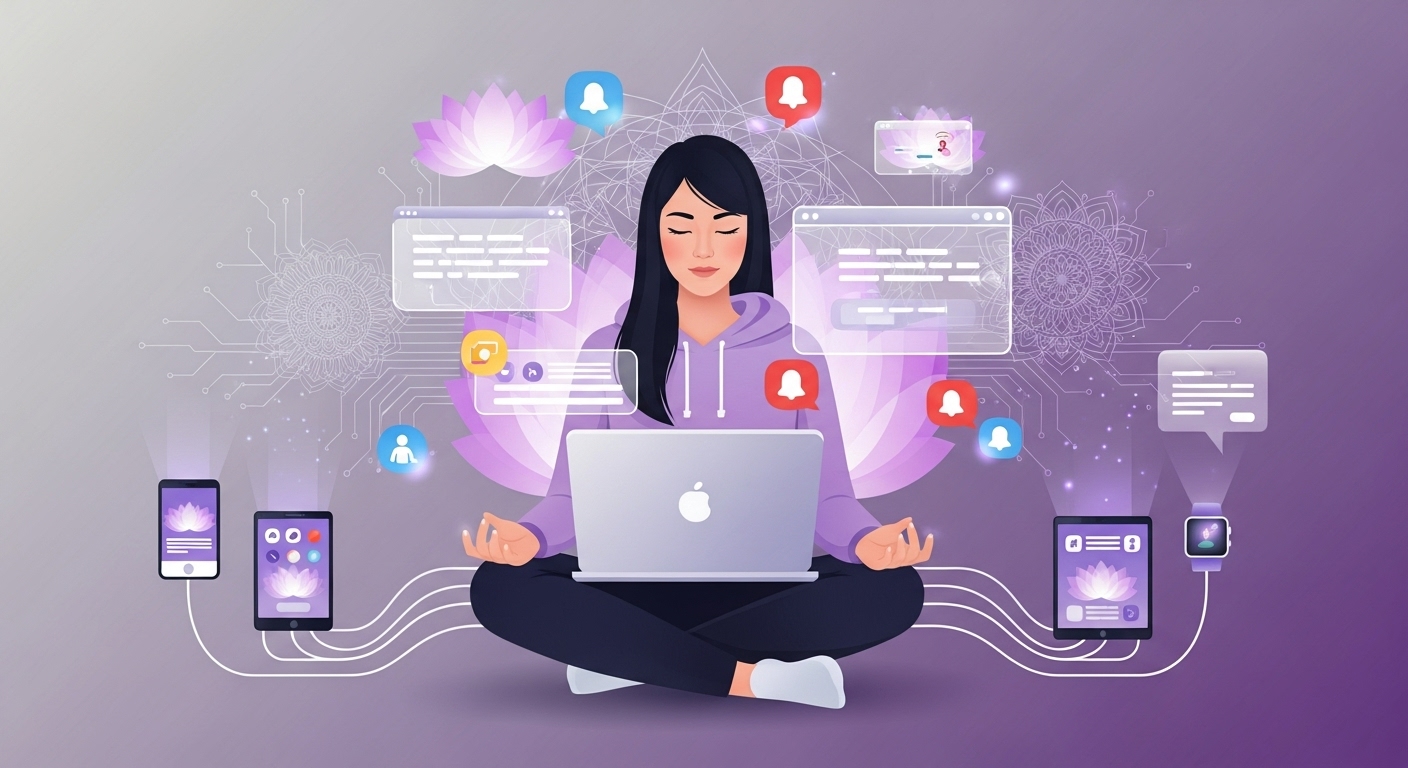
I shipped a feature to 14 million users on a Tuesday. By Wednesday I was sitting in my car in the parking garage, engine off, staring at a concrete wall, feeling nothing. Not sad. Not stressed. Just hollowed out, like someone had run truncate on my inner life and left the file empty but still taking up space.
For three years at my last company, I built notification systems. Engagement funnels. The little red badges designed to pull people back into apps. I was good at it. The metrics said so. The performance reviews said so. The stock options said so. Something in my chest disagreed, but I’d gotten skilled at ignoring processes I didn’t want to read the output of.
When I finally told people I was burning out, the advice was unanimous: unplug. Do a digital detox. Delete your apps. Go off-grid for a week.
That advice makes sense if you’re a freelance writer or a yoga instructor. It’s useless if your livelihood is screens. Telling a software engineer to “just put the phone down” is like telling a surgeon to stop using their hands. The tool isn’t the problem. The relationship with the tool is the problem. And nobody was offering me a way to fix the relationship without amputating the limb.
I found it eventually — not in a retreat or an app or a ten-step program, but in stories. Meditation stories that understood my world instead of judging it. Stories that spoke in metaphors I recognized, from systems I’d actually built. That was the turning point.
Why Tech Workers Need a Different Kind of Meditation
Most meditation content has a quiet anti-tech bias running underneath the calming music. The guided sessions ask you to “leave your devices behind.” The retreat centers advertise “no screens.” The books tell you that your phone is fragmenting your attention and you need to return to some pre-digital state of wholeness.
If you write code for a living, or manage infrastructure, or design interfaces, this framing makes you feel like your entire career is a spiritual disease. You sit down to meditate, and the subtext is: the thing you do for eight hours a day is the enemy of the thing you’re trying to feel right now.
No wonder most tech workers try meditation and quit within a month.
I tried quitting screens for a weekend once. By Saturday afternoon I was anxious about the deployment I couldn’t monitor, guilty about the Slack messages I wasn’t answering, and resentful of the meditation timer that was supposed to be fixing me. The “detox” was more stressful than the toxin.
Here’s what I’ve figured out since: you don’t need to reject technology to find presence. You need to pay attention to how you run it. The difference between mindless scrolling and mindful engagement isn’t the device. It’s the awareness of the person holding it.
Stories work for technical minds because they give abstraction a shape. When someone tells me to “observe my thoughts without attachment,” I don’t know what to do with that. When a story describes thoughts as background processes consuming CPU while you’re trying to run something important — I get it. I know what to do with processes. I’ve been killing them since I was fourteen.
You don’t need to become a Luddite. You need to start paying attention.
Aria’s Digital Meditation Stories
Over the past year, I’ve been writing and recording meditation stories for Waylight Stories that use the language of technology to talk about what’s going on inside. Not because tech metaphors are clever, but because they’re how a lot of us actually think. Here are the ones that seem to land hardest.
Digital Presence: Logging In with Intention
This episode came from something I noticed about my own mornings. I’d wake up, grab my phone, and within thirty seconds I was already somewhere else — in my inbox, in the news, in someone else’s crisis. I never consciously decided to start my day that way. I just… logged in without intention, and the system took over.
The story reframes that first moment of screen contact as a login prompt. You wouldn’t type your password into a random terminal without checking what system you’re connecting to. Why do you hand your attention to your phone without checking what you’re connecting to? It’s a small reframe, but it sticks.
The Blue Screen of the Soul
This one is about burnout — real burnout, not the “I need a vacation” kind but the “I’m staring at a concrete wall feeling nothing” kind. The metaphor maps a system crash to what happens when you’ve been running too many processes for too long without a restart. Your OS doesn’t blue-screen because it’s weak. It blue-screens because it was doing too much.
I wrote this after my own crash. The thing about a blue screen is that it’s not a failure of the system — it’s the system protecting itself from a worse failure. Burnout works the same way. Your body isn’t broken. It’s forcing a shutdown because you wouldn’t do it voluntarily. The story walks you through what a conscious reboot looks like.
Sacred Protocols: Notification Bells as Mindfulness Reminders
This practice is the most practical thing I’ve made. It takes the notification sounds that already interrupt you fifty times a day and repurposes them as mindfulness bells. Instead of each ping triggering a reactive grab for your phone, you use it as a cue: one breath, notice where you are, then decide whether to engage.
It works because it doesn’t add anything to your day. It hijacks an existing interrupt and rewrites the handler. Same signal. Different response. I’ve been doing this for over a year. Of everything I’ve tried, this one stuck the hardest.
The 3 AM Digital Paradox
This story came from the nights I know too well — 3 AM, can’t sleep, so you reach for your phone, which makes you more awake, which makes you more anxious, which makes you scroll harder. A perfect feedback loop with no exit condition.
The episode doesn’t tell you to put the phone down. It meets you in the scroll. It narrates the loop while you’re in it, gives you enough self-awareness to see the pattern executing in real time. Sometimes that’s enough to break the cycle. Sometimes it isn’t. But at least you know what’s running.
4 Meditation Stories for the Digital Life
Beyond the episodes, here are four short stories you can run in your head whenever you need them. Think of them as scripts: lightweight, no dependencies, executable anywhere.
The Cursor Blink
You’ve just closed a tab or finished a task. The cursor blinks in an empty document. Most of us immediately fill the silence — open a new tab, check a notification, start typing something. Instead: watch the cursor blink. Just for thirty seconds. That blinking cursor marks time without demanding anything from you. It’s the simplest meditation I know. One blinking line on a white field. Nothing to do. Nowhere to go. Just the rhythm of something waiting patiently for you to be ready. Practice this between tasks, between meetings, between Slack threads. Thirty seconds of watching the cursor is thirty seconds where your attention belongs to you.
The Update Cycle
Your mind feels slow. Foggy. You can’t concentrate and you’re starting to panic about the deadline. Here’s the reframe: you’re not broken. You’re installing an update. Every system needs downtime to process what it’s taken in. You’ve been absorbing information all day — meetings, messages, code reviews, conversations. Your brain is integrating it. The progress bar is at 63% and you’re trying to force-quit the installation. Stop. Let the update run. Sit with the fog for five minutes instead of fighting it. The processing will finish faster if you stop interrupting it. Use this when you feel mentally sluggish and guilty about it. The slowness isn’t a malfunction. It’s maintenance.
The Clean Install
Close your eyes. Imagine your mind as a hard drive that hasn’t been wiped in years. There are thoughts running in the background that you installed so long ago you forgot they were there. The “I’m not good enough” process, launched in middle school, still consuming memory. The “something bad is about to happen” daemon, started after that one bad quarter, still polling for threats. The “I need to be productive every second” cron job, scheduled by a version of you that no longer exists. You don’t need to hunt down every process. Just notice what’s running. Open the task manager. See the list. Some of those background processes served you once. They don’t anymore. You can’t force-quit them all at once, but you can start choosing which ones to let run and which ones to stop feeding resources. Use this when you feel mentally cluttered and can’t identify why.
The Dark Mode
Not everything needs to be off or on. Your phone has a dark mode for a reason — it reduces the strain without eliminating the function. You can do the same thing with your mind. Instead of powering down completely (which some of us genuinely can’t do — the anxiety of total disconnection is worse than the fatigue of staying connected), try dimming. Lower the brightness on your engagement. Respond to messages with fewer words. Let some emails sit until morning. Close three tabs out of thirty. You’re not shutting down. You’re reducing luminance. Use this in the evening when you’re tired but can’t stop. You don’t need to choose between full power and off. There’s a whole spectrum of low-power states available to you.
A Tech Worker’s Meditation Routine
I don’t have a meditation practice in the way most people imagine — no cushion, no incense, no dedicated room. I have a set of protocols that run at predictable intervals throughout my day. Think of it as a cron schedule for awareness.
Morning: The 4-4-6 Breathing Reset. Before I open my laptop, before I check my phone, I do four rounds of 4-4-6 breathing. Inhale for 4, hold for 4, exhale for 6. Takes about ninety seconds. This isn’t spiritual. It’s mechanical. The extended exhale activates the parasympathetic nervous system. I’m literally downregulating my cortisol response before the first notification hits. I wrote more about why this works in my piece on meditation for anxiety.
Workday: The Notification Bell Practice. One notification sound — for me it’s my calendar alert — becomes a mindfulness trigger. When it fires, I take one conscious breath before responding. That’s it. Over the course of a workday, that’s fifteen to twenty micro-meditations I didn’t have to schedule.
Evening: One Story on the Way Home. After I close my last tab (or after I tell myself I’m closing my last tab and then actually close three more), I listen to one Waylight Stories episode. On the train, on a walk, sometimes just at my desk with my eyes closed. The stories are around ten to fifteen minutes. They don’t ask me to leave my world. They meet me in it.
None of this requires quitting tech. None of it requires a retreat or a sabbatical or a weekend off the grid. It works because it fits into the life I actually have, not the one some wellness influencer thinks I should want.
Start Debugging Your Mind
If you’ve tried meditation and bounced off it, or never tried because every option felt like it was built for someone else, start here.
Listen to Digital Presence. It’s the episode I wish existed when I was sitting in that parking garage feeling empty. It takes about twelve minutes and it won’t ask you to throw away your laptop.
Then browse the meditation stories collection, or check out my other writing and episodes if you want more on the integration approach.
You can find all episodes on the episodes page, or subscribe wherever you listen — Spotify or Apple Podcasts.
Your mind isn’t broken. It’s just running too many processes without enough awareness of what’s in the task manager. You don’t need to shut it all down. You need to start reading the logs.
About Aria Chen
Digital Wellness Expert & Former Software Engineer
Aria Chen is a digital wellness expert and former Silicon Valley software engineer who specializes in mindfulness for technology professionals. She created the sacred protocols method for intentional technology use and teaches tech workers how to build healthier habits around screens.
You might also enjoy
Meditation Stories for Anxiety: How Narrative Calms the Nervous System
Anxiety makes traditional meditation harder — your brain won't stop. Meditation stories give your mind something to follow instead of spiral. Here's how narrative calms what silence can't.
Meditation for Anxiety: What Actually Helps When Your Brain Won't Stop
Most anxiety meditation advice tells you to 'just relax.' Here's what actually works — from a former software engineer who spent years debugging her own nervous system.
Digital Mindfulness: Why You Don't Need a Digital Detox to Find Peace
You don't need to unplug to find peace. Digital mindfulness means using your screens with intention. A guide to integrating meditation with your always-connected life.