Meditation for Anxiety: What Actually Helps When Your Brain Won't Stop
Most anxiety meditation advice tells you to 'just relax.' Here's what actually works — from a former software engineer who spent years debugging her own nervous system.
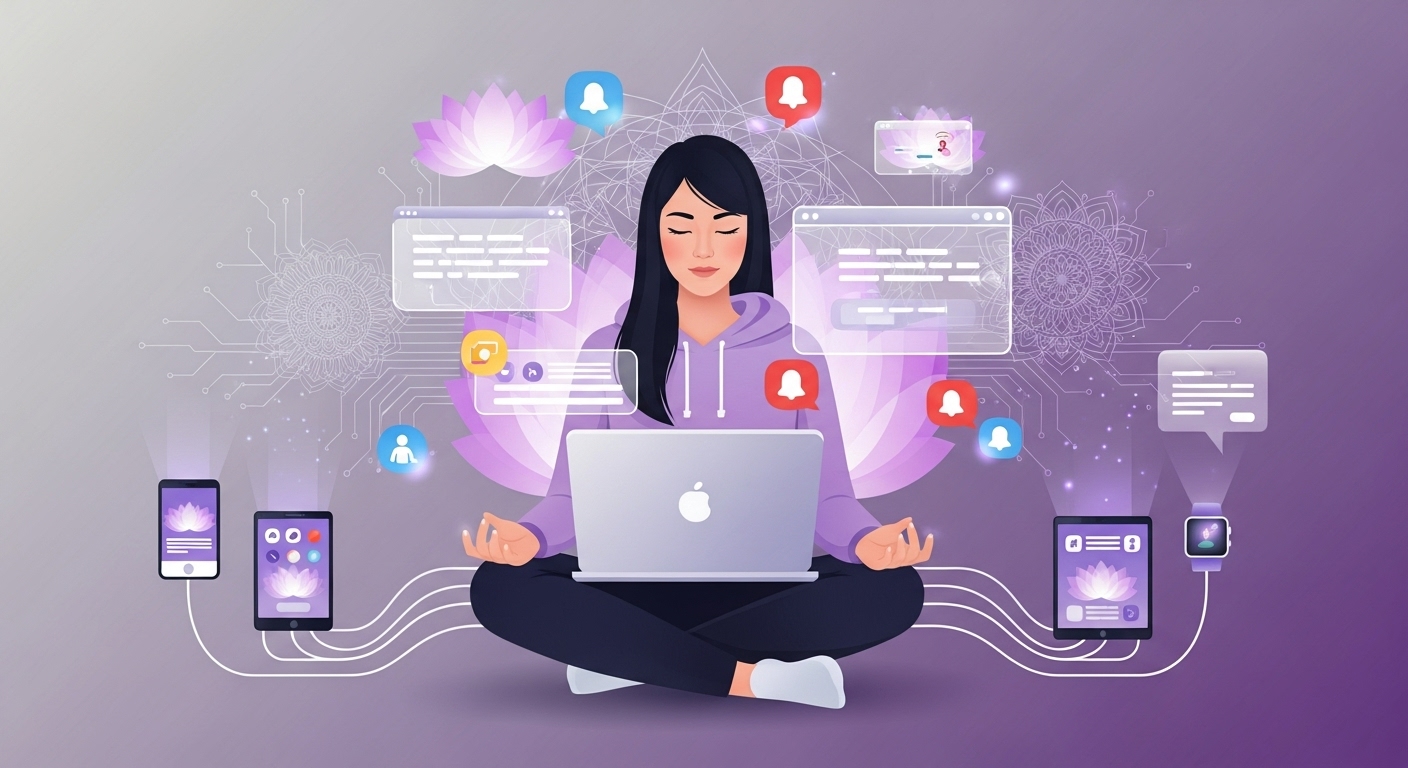
Tuesday. 2:17 AM. I’m lying in bed with my eyes closed, which technically looks like sleeping, but my brain is running a process I never authorized. It’s replaying a Slack message I sent six hours ago. Did that come across passive-aggressive? The word “fine” is doing a lot of work in that sentence. My chest tightens. My jaw locks. Now I’m thinking about the sprint review on Thursday, which cascades into the quarterly goals I haven’t touched, which spirals into whether I’m even good at my job, which somehow lands on a weird thing I said at a party in 2019.
The whole sequence took maybe ninety seconds. My nervous system didn’t get the memo that none of this is happening right now.
That’s what anxiety actually feels like. Not the soft-focus stock photo version where someone stares out a window looking attractively troubled. It’s mechanical. It loops. Your body responding to threats that exist only as electrical impulses in your prefrontal cortex.
I’ve spent years trying to fix this. Here’s what I’ve learned.
Why “Just Relax” Is Terrible Advice
If you’ve ever Googled “meditation for anxiety,” you’ve hit the wall of useless platitudes. Let go of your thoughts. Find your calm center. Simply relax into the present moment.
Simply. As if the problem is that you forgot to flip the relaxation switch.
Here’s why that advice fails: anxiety isn’t a decision. It’s a nervous system state. Your amygdala detected a threat (real or imagined, it doesn’t care) and flooded your body with cortisol and adrenaline. Telling an anxious person to “just relax” is like telling a computer to “just stop” while a script is running. The process is already executing. You can’t skip it with good intentions.
And then there’s the guilt loop. You try to meditate. Your brain won’t settle. You decide you’re bad at meditating, which becomes another thing to be anxious about. Now you’ve got anxiety about your anxiety meditation. Recursive function, no base case.
Most meditation-for-anxiety guides assume a baseline level of calm to start from. They’re really stress techniques. Stress is situational. Anxiety is your operating system, not an app.
The Debugging Approach to Anxiety
When I was writing code and hit a bug, I didn’t try to delete it by force. (That causes more problems. Ask me about the time I rm -rf’d a config directory in production.) You observe it first. Read the error log. Figure out what’s triggering it. Then you work with the system, not against it.
Anxious thoughts respond to the same approach.
The first step is something therapists call “cognitive defusion,” but I think of it as reading the stack trace. Instead of believing the thought (“I’m going to fail, everyone will know I’m a fraud”), you observe it like a log entry. Oh, there’s the impostor syndrome thread again. Fires most often on Sunday nights. Interesting.
You’re not trying to stop the thought. You’re changing your relationship to it. The thought still runs. But you stop treating every anxious prediction like a confirmed diagnosis.
This takes practice. The first fifty times, you’ll observe the thought and immediately get sucked back into believing it. That’s normal. The skill isn’t never getting caught. It’s noticing sooner.
I keep a mental catalog of my anxiety’s greatest hits. The “you’re falling behind” track. The “that email was a mistake” remix. The “what if something bad happens to someone I love” deep cut. The 3 AM classic, “remember that dumb thing you said in 2016.” When I recognize the pattern, it loses about 30% of its power. Not all. But enough.
Two Practices That Actually Help
I’ve tried a lot of anxiety meditation techniques over the years. Most were fine. Forgettable. Two actually changed things.
The 4-4-6 Breathing Reset
This works because it’s mechanical, not philosophical. You don’t need to believe anything or feel anything. You just need to count.
Inhale for 4 counts. Hold for 4 counts. Exhale for 6 counts. That’s it.
The exhale being longer than the inhale is the whole trick. It activates your parasympathetic nervous system. Not a metaphor. Not a visualization. Actual physiology. Your vagus nerve doesn’t care whether you believe in meditation. It responds to CO2 levels and diaphragm pressure. I find that weirdly reassuring.
I do this in meetings when my heart starts racing. In bed when the 2 AM spiral kicks off. In the bathroom before a presentation, because apparently I’m a person who does breathing exercises in bathrooms now. Nobody can tell you’re doing it. Four rounds usually shifts something. Sometimes it takes ten.
The Notification Bell Practice
I wrote about this in my Sacred Protocols piece, but it’s worth repeating in the context of anxiety specifically. Choose one notification sound on your phone. Just one. Every time it goes off, take a single breath and notice where you are.
For anxiety, this does something different than regular mindfulness. You’re not finding peace. You’re interrupting the pattern. Anxiety runs like a background process consuming all your CPU. The notification bell forces a context switch. For two seconds, you’re here. In your body. In the room. Then the anxiety comes back, probably. That’s fine. You interrupted it. Over weeks, those micro-interruptions add up to something.
I talked about how this practice connects to a bigger picture of digital presence in Episode 4 of Waylight Stories. The short version: your phone is already interrupting you all day. You might as well make those interruptions work for you.
When Meditation Makes Anxiety Worse
This is the section most meditation blogs won’t write.
Sometimes sitting still with your thoughts is the worst possible thing you can do. If your anxiety is spiking hard — hands shaking, chest caving in — closing your eyes and “going inward” can intensify the spiral. You’re locking yourself in the room with the thing that’s scaring you.
When I’m that activated, I don’t meditate. I move. Walk around the block. Do pushups until my arms shake for a physical reason instead of a psychological one. Hold ice cubes, which looks unhinged but genuinely works. Run cold water over my wrists. None of this is spiritual. It’s just giving your body a real sensory signal loud enough to compete with the imagined threat.
There’s also a kind of anxiety that meditation can’t touch. If you’re having panic attacks regularly, if your baseline never drops below a five out of ten, if you’ve been meditating for months and nothing’s moving, talk to a professional. A therapist. A psychiatrist. Medication if that’s what it takes. I take an SSRI. It’s not a failure. It’s load balancing. Some of us got hardware that needs a patch before the software fixes can take.
Meditation is a good tool. But treating it like a cure-all is how people end up feeling broken when it doesn’t fix everything.
If anxiety is keeping you up at night, Luna wrote about an evening meditation practice for sleep that I’ve tried myself.
What I Actually Believe
I don’t think meditation eliminates anxiety. I’ve been practicing for four years, and I still have nights where my brain decides 3 AM is the perfect time to audit every decision I’ve ever made. The difference is smaller than you’d hope. I recognize the process now. I can name it. Sometimes I can interrupt it. And on the nights I can’t, I know it’ll pass, which is a boring kind of wisdom but a real one.
That’s not a transformation story. It’s not going to sell a course or fill a retreat. But it’s what’s true.
Your anxiety is not a bug to be fixed. It’s a feature of a nervous system that’s trying, clumsily, to keep you safe. You can’t uninstall it. You can learn to hear the alarm go off and not burn down the house in response.
Start with the breathing. 4-4-6. Right now, if you want. Your vagus nerve is ready when you are.
Meditation Stories for Anxious Minds
One more thing. Everything above is active technique — stuff you do when anxiety is already running. But I’ve found that meditation stories work on a different layer. They’re preventive.
When I listen to a story that understands what anxiety feels like — not a calm voice telling me to relax, but a narrative that starts in the chaos and slowly finds its way to something quieter — my baseline shifts. Not during the story. After. The next morning. The cortisol starts lower. The spiral takes longer to spin up.
Stories give an anxious brain something to follow that isn’t its own fear. That’s not a small thing. The anxious mind is desperate for input. Give it silence and it generates worst-case scenarios. Give it a story and it follows the narrative instead. It’s redirection, not suppression.
I wrote more about this in meditation stories for anxiety — how narrative calms the nervous system in ways that instruction can’t. And the full collection of meditation stories has options organized by what you’re dealing with, whether that’s anxiety, sleep, stress, or the general feeling that your brain has too many tabs open.
About Aria Chen
Digital Wellness Expert & Former Software Engineer
Aria Chen is a digital wellness expert and former Silicon Valley software engineer who specializes in mindfulness for technology professionals. She created the sacred protocols method for intentional technology use and teaches tech workers how to build healthier habits around screens.
You might also enjoy
Meditation Stories for Anxiety: How Narrative Calms the Nervous System
Anxiety makes traditional meditation harder — your brain won't stop. Meditation stories give your mind something to follow instead of spiral. Here's how narrative calms what silence can't.
Digital Detox Through Stories: Meditation for Tech Workers
Aria Chen built apps used by millions and felt emptier than ever. She didn't reject technology — she rewired her relationship with it. Meditation stories for people who can't just 'put the phone down.'
Digital Mindfulness: Why You Don't Need a Digital Detox to Find Peace
You don't need to unplug to find peace. Digital mindfulness means using your screens with intention. A guide to integrating meditation with your always-connected life.