Meditation Stories for Anxiety: How Narrative Calms the Nervous System
Anxiety makes traditional meditation harder — your brain won't stop. Meditation stories give your mind something to follow instead of spiral. Here's how narrative calms what silence can't.
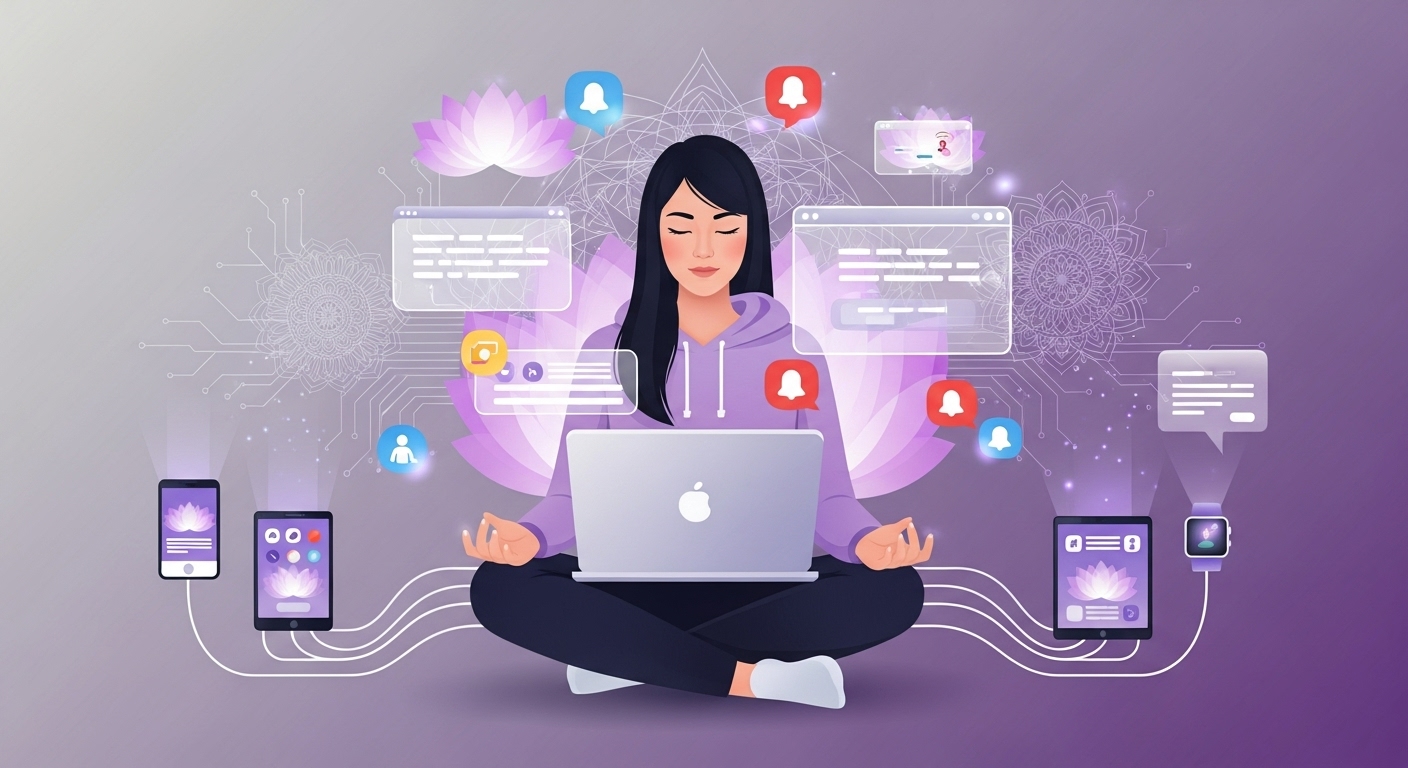
Wednesday. 2:48 AM. The ceiling is doing that thing where it becomes a projection screen for every mistake I’ve ever made. Tonight’s feature presentation: a code review comment I left three months ago that might have come across as condescending. My brain has helpfully reconstructed the exact phrasing, the probable emotional response of the recipient, and seven alternate timelines where I worded it differently. None of this is useful. All of it feels urgent.
I’ve written before about what anxiety actually feels like. The mechanical looping, the nervous system hijack. The way your body treats a remembered email like a bear attack. And I’ve shared techniques that help. The 4-4-6 breathing. The notification bell practice. They work. I stand by them.
But that night, none of it was landing. I’d count the breaths and my brain would run the anxiety subroutine in parallel. Multithreading, except both threads were me and one of them was panicking. The silence between breaths was just more space for the spiral to fill.
What finally broke the loop was an accident. I put on a meditation that told a story. Some narrative about walking through a quiet building, checking rooms, turning off lights one by one. I don’t remember the specifics. What I remember is that for the first time in hours, my brain had somewhere to go that wasn’t the spiral. It followed the story like a process following instructions. By the time the last light switched off, I was asleep.
That felt worth investigating.
Why Anxious Minds Need Stories, Not Silence
Here’s the paradox nobody in the meditation world talks about enough: telling an anxious person to clear their mind is like telling someone with insomnia to just fall asleep. The instruction requires the thing it’s supposed to produce. Your mind won’t clear because the anxiety is what’s filling it, and the anxiety doesn’t respond to eviction notices.
Silence makes it worse. I know that’s heresy in meditation circles. But when your brain is generating threat predictions at industrial scale, removing all external input just gives the threat generator more room to work. It’s like deleting every app on your computer and expecting the CPU usage to drop, except the process eating all your resources is the operating system itself. You can’t quit the OS.
Stories solve this differently. A narrative gives your attention an external track to follow. Not a demand. Nobody’s asking you to concentrate or achieve anything. Just something to listen to. Your brain, desperate for input that isn’t its own catastrophizing, grabs onto the story like a lifeline.
In my anxiety post, I talked about cognitive defusion — observing your anxious thoughts like log entries instead of treating them as confirmed diagnoses. Stories create defusion without trying to. You can’t fully believe the thought “everything is falling apart” while you’re also tracking a character walking through a forest. The narrative occupies the same cognitive real estate that the anxiety wants. It’s not fighting the anxiety. It’s just… already sitting in that chair.
An anxious brain is an overloaded CPU running a thousand speculative processes about the future. A meditation story is a single, manageable task that the CPU can actually execute. Follow this character. Picture this place. The system calms down because you gave it something it could actually do, not because you forced it to stop.
My Approach to Anxiety Meditation Stories
I spent a decade in Silicon Valley writing code that processed millions of data points. Then I spent several years trying to process my own inner data without any of the tools I’d built for machines. The irony was obvious.
When I started creating meditation stories, I wanted to make the kind of thing I wished existed during my worst anxiety nights. Not ocean sounds with a calm voice telling me to release tension. Something that met me where I actually was. Wired. Scattered. Brain running hot, seventeen metaphorical browser tabs competing for attention.
So my stories start in the noise. The digital chaos. The notification overload. Because that’s where anxious people live. We don’t start calm and get disrupted. We start disrupted and occasionally, with real effort, find a few seconds of calm. Any story that opens with “you’re walking peacefully through a meadow” has already lost me. I’m not in a meadow. I’m in a room at 2 AM with a heart rate that suggests I’m being chased.
The Sacred Protocols I developed use everyday digital experiences as anchor points: the sound of a notification, the act of closing a browser tab, the loading screen between tasks. These aren’t random metaphors. They’re the actual texture of a modern anxious Tuesday. When I build a story around them, it works because it starts from recognition. Oh, she gets it. She’s describing my Tuesday.
From there, the stories move. Gradually. No hard cut from chaos to serenity. A slow dimming. The notifications get quieter. The tabs close one by one. The screen brightness drops. By the end, silence arrives because the noise was handled. Not because someone told you to pretend it wasn’t there.
3 Meditation Stories for When Anxiety Hits
These are frameworks from episodes I’ve built for Waylight Stories. Each one uses a different entry point because anxiety isn’t one thing. Sometimes it’s racing thoughts. Sometimes scattered attention. Sometimes it’s the 3 AM variety, which has its own particular flavor of dread.
The Notification Silence
You’re standing in a control room. Screens everywhere, each one pinging with alerts. Some are urgent. Most aren’t. A few are alerts about other alerts — your system monitoring its own panic. The practice is simple: you walk to each screen, read the notification, and decide whether it needs action right now. Almost none of them do. You acknowledge each one and silence it. Not dismiss. Silence. The information is still there. You’re just turning off the alarm. By the end, the room is quiet. Not because the screens are off, but because you triaged the noise.
What it practices: Sorting anxious thoughts from genuine concerns without suppressing either. It’s the cognitive defusion technique wrapped in a story you can actually follow at 2 AM.
When to use it: Racing thoughts. The “everything is urgent” feeling. When your brain has decided that twelve things need your attention simultaneously.
Closing the Tabs
Your mind is a browser with too many tabs open. Each one is a worry — the unfinished project, the awkward conversation, the bill you forgot, the health thing you’ve been ignoring. The practice walks you through each tab. You look at what’s there. You decide: is this something I can act on right now? If yes, you bookmark it for tomorrow. If no, you let it close. The click of each tab closing is a small release. Some tabs resist. That’s fine. You leave them. But the ones that close lighten the load.
What it practices: Dealing with fragmented attention and the specific anxiety of having too many unresolved things competing for mental space.
When to use it: When you’re overwhelmed by volume. Not one big fear, but thirty small ones stacked on top of each other.
The 3 AM Reboot
This one I made for myself first, because 3 AM and I have a complicated relationship. You’re lying in the dark. Your system has crashed — not dramatically, just frozen. Stuck in a loop. The story guides you through a gentle restart sequence. Not a hard reboot, not a factory reset. Just: close the processes that aren’t serving you. Clear the cache. Let the system start fresh. It walks through the body the way a boot sequence initializes hardware — feet first, then legs, then core, then hands, then chest, then face. Each section comes online clean.
What it practices: Releasing physical tension that accumulates during anxiety spirals. The body scan, but with a narrative frame that gives your brain something to follow instead of something to fail at.
When to use it: Middle-of-the-night anxiety. The kind where you’ve been lying in the dark for an hour and your body has turned into a clenched fist.
Building an Anxiety Toolkit with Meditation Stories
One story won’t fix your anxiety. I want to be upfront about that because I’ve read too many articles that promise a cure from a single technique. It’s never true.
What works is layering. Building a toolkit and reaching for the right tool at the right time.
Daily practice: One story in the morning before you check your phone. Not to fix anything. To establish a baseline. Like running a system check before the day loads its demands onto your hardware. I do this maybe five mornings out of seven. The days I skip aren’t disasters. The days I don’t skip are slightly better. Over months, “slightly better” compounds into something real.
Acute moments: When anxiety spikes hard, you need something short. A three-minute story, not a twenty-minute guided session. Something that can interrupt the pattern fast enough to matter. I’m building more of these — short meditation stories designed for the panic moments, the ones where you need a circuit breaker, not a seminar.
Long-term: This is the part that surprised me. When you follow the same characters over time, when you return to the same narrative world across multiple episodes, something builds up. You build a relationship with the story. The calm it produces becomes more accessible because your brain already knows the path. Muscle memory, but for your nervous system. The tenth time you visit that quiet control room, you arrive calmer than the first time. Your brain has cached the route.
Each repetition gets a little faster at producing calm, a little more efficient at interrupting the loop. Not because the story changes. Because you do.
What Research Says About Narrative and Anxiety
I read research papers the way some people read novels. Late at night, usually when I should be sleeping, often as a socially acceptable alternative to doom-scrolling. So here’s what I’ve found.
Bibliotherapy (using stories as a therapeutic tool) has been studied since the 1930s. It works partly through identification (seeing yourself in a character normalizes your experience) and partly through cognitive engagement (following a narrative occupies the working memory that anxiety wants to commandeer). A 2017 meta-analysis in PLOS ONE found that narrative-based interventions significantly reduced anxiety symptoms, with effect sizes comparable to some structured therapy programs.
There’s also the cortisol angle. Engagement with fictional narratives has been shown to reduce cortisol levels, the stress hormone that spikes during anxiety. Your body can’t tell the difference between “I’m safe because the threat passed” and “I’m safe because I’m absorbed in a story.” The physiological outcome is the same: parasympathetic activation, reduced heart rate, muscle relaxation.
And here’s what matters most for anyone trying to build a practice: people stick with story-based meditation at higher rates than instruction-based meditation. Stories are something your brain wants to do. Following a narrative isn’t discipline. It’s entertainment that happens to calm your nervous system.
But I should be honest: I’m not a neuroscientist. I’m a former software engineer who reads papers at 2 AM instead of doom-scrolling. I find the research compelling. I’ve also experienced it personally. Both of those things can be true and still not constitute medical advice.
Start Your Practice
If anxiety is the thing that brought you here, start with The Notification Silence. It’s the closest to what most people experience: the racing, the urgency, the feeling that twelve things need you right now.
You can find it and the other stories on the Meditation Stories page, or look through the full episode catalog. If you want more context on my approach and background, there’s my character page, though calling it a “character page” makes me sound like an NPC. Some days that’s not far off.
For the non-story techniques (the breathing, the notification bell practice, the honest section about when meditation makes anxiety worse), read my earlier piece: Meditation for Anxiety: What Actually Helps When Your Brain Won’t Stop.
And if you want to listen while you fall asleep or during a commute panic spiral, Waylight Stories is on Spotify and Apple Podcasts.
Your anxiety is going to keep running. That’s what it does. But you don’t have to sit alone in the noise. Sometimes the most useful thing isn’t silence. It’s a story that walks you somewhere quieter, one sentence at a time.
About Aria Chen
Digital Wellness Expert & Former Software Engineer
Aria Chen is a digital wellness expert and former Silicon Valley software engineer who specializes in mindfulness for technology professionals. She created the sacred protocols method for intentional technology use and teaches tech workers how to build healthier habits around screens.
You might also enjoy
Meditation for Anxiety: What Actually Helps When Your Brain Won't Stop
Most anxiety meditation advice tells you to 'just relax.' Here's what actually works — from a former software engineer who spent years debugging her own nervous system.
Digital Detox Through Stories: Meditation for Tech Workers
Aria Chen built apps used by millions and felt emptier than ever. She didn't reject technology — she rewired her relationship with it. Meditation stories for people who can't just 'put the phone down.'
Digital Mindfulness: Why You Don't Need a Digital Detox to Find Peace
You don't need to unplug to find peace. Digital mindfulness means using your screens with intention. A guide to integrating meditation with your always-connected life.