Bedtime Meditation Stories for Adults Who Can't Turn Off Their Brain
You're not a child who needs a bedtime story. Except — you kind of are. Why bedtime meditation stories work for adult brains, and how nature narratives help you finally stop thinking and sleep.
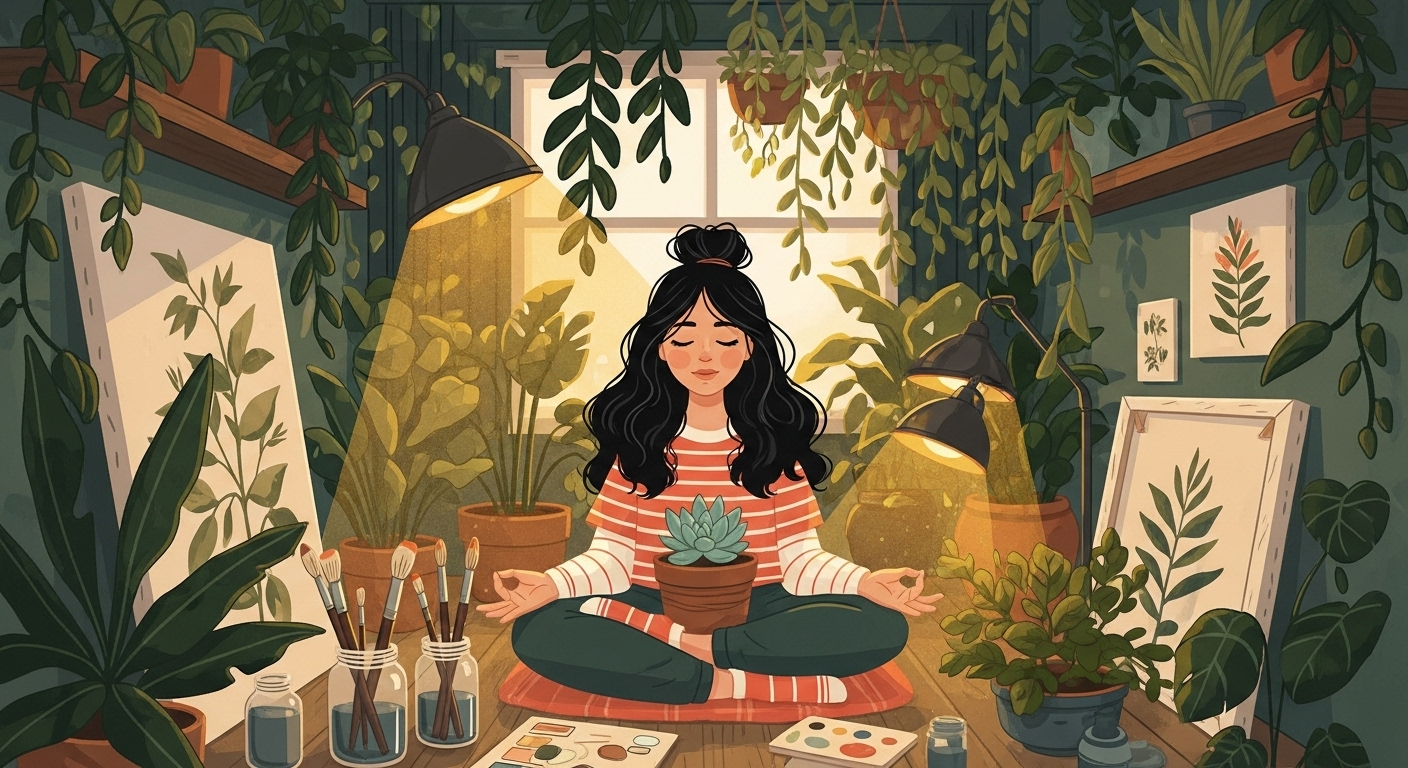
Nobody read me a bedtime story last night. Nobody has in about twenty-five years. And somewhere in that gap — between the last time someone sat on the edge of my bed and turned pages in a low voice, and now, when I lie awake composing grocery lists at 1am — I lost something I didn’t know I needed.
We stopped getting bedtime stories around age ten. Maybe earlier. And we never replaced that ritual with anything. We just started going to bed like machines powering down: teeth, face, pillow, done. As if the mind is a light switch. As if falling asleep doesn’t require falling at all, just… stopping.
But you don’t stop. I don’t stop. The brain has no off button and it never did.
Here’s what I’ve noticed about plants. At dusk, they begin their transition long before dark actually arrives. My prayer plant starts folding its leaves while the sky is still streaked with pink. The process takes twenty, sometimes thirty minutes of slow, deliberate closing. The plant doesn’t wait for darkness and then scramble. It prepares. It gives itself a bridge between awake and asleep.
That bridge, for a lot of us, used to be a story. Someone’s voice, carrying us from here to somewhere else, somewhere quieter. We outgrew the ritual. We never outgrew the need.
The Science of Bedtime Stories for Adult Brains
There’s a concept in sleep research called cognitive shuffle theory. The idea is simple. When you give the brain an undemanding narrative to follow — something with low stakes, gentle imagery, no cliffhangers — it displaces the rumination loop. Your mind can’t simultaneously worry about tomorrow’s meeting and follow a story about rain falling on a meadow. It has to choose one. And if the story is boring enough, warm enough, slow enough, the thinking mind relaxes its grip.
This isn’t weakness. It’s architecture. Your brain is built to follow narrative. It has been doing it since before written language existed, since firelight and someone’s voice in the dark were the last things you experienced before sleep. The format hasn’t changed. Just the delivery.
What makes bedtime meditation stories different from regular audiobooks or podcasts is pacing. A good sleep story slows down as it goes. Sentences get longer. Details get softer. The narrator’s voice drops. And your nervous system, which is always listening even when you think you’re not paying attention, matches that deceleration. The story slows, and you slow with it.
Nature imagery matters here too. Research on parasympathetic activation shows that even imagined natural settings — a forest, a river, rain on leaves — trigger the body’s rest response. Your heart rate decreases. Your muscles soften. And this works whether you’re lying in a cabin in Vermont or a third-floor walkup in Queens with a fire truck going by outside.
The important part, the part that feels counterintuitive: nothing much should happen in the story. No plot twists. No dramatic tension. The narrative equivalent of watching clouds. This is the permission structure. A story where nothing happens is your brain’s way of hearing: Nothing needs your attention right now. You can go.
I wrote about my prayer plant’s leaf-folding in my meditation for sleep post, how watching it close up gave me the idea for the Closing Leaves Breath. But what I didn’t say there was that I often pair that breath practice with a story. The breath is the physical bridge. The story is the mental one. Together, they build a corridor from wakefulness to sleep that my body has learned to trust.
Luna’s Bedtime Story Collection
When I started writing meditation stories for Waylight, I wasn’t thinking about bedtime. I was thinking about presence. About what happens when you slow down enough to notice the veins on a leaf or the way wet pavement smells after the first rain in weeks.
But people kept telling me: I fell asleep listening to your episode. At first, I took it as criticism. Then I realized it was the highest compliment a sleep-deprived person can give.
The Concrete Blooms series grew out of that realization. Those stories are about finding nature in unlikely places: a dandelion in a sidewalk crack, moss on a fire escape, a hawk circling above a parking garage. I wrote them for daytime listening, but the pacing works for evening too, because the whole premise is about slowing down enough to see what’s already there. And slowing down enough to see is only one step away from slowing down enough to sleep.
I think about seasons when I write evening stories. Winter stories move differently than spring ones. A winter story is heavy. Thick snow. Long silences. The smell of wood smoke and cold stone. Everything is still and buried, and that stillness gives you permission to feel buried too, in your blankets, in the dark. A spring story has more movement — sap rising, birdsong, ice cracking on a pond — but it’s the movement of waking up, which means it works when you’re coming out of a difficult period and sleep has been tangled up with anxiety. The renewal says: something new is starting, and you can rest into it.
My approach to every bedtime meditation story follows one pattern. I start you somewhere slightly active. A walk through a garden at dusk. Standing at the edge of a tide pool. Sitting in a greenhouse while rain hits the glass. There’s enough sensory detail to give your mind something to hold, the way you might hold a warm mug. Then, gradually, the frame narrows. The walk becomes standing still. The tide pool becomes just one anemone, pulsing slowly. The greenhouse becomes just the sound of rain, then just the warmth, then just your breathing.
I use sensory detail like weight. Warm soil on bare feet. The heaviness of August air before a thunderstorm. The dense, sweet smell of overripe figs. Thick moss under your palms. Each detail is chosen to make you feel heavier, more held, more pressed gently into wherever you are. By the end, the story isn’t carrying you anymore. You’ve sunk below it.
You can find the full collection on the episodes page. Start anywhere. But if you’re reading this at night, start with the one I recommend at the end of this post.
Creating Your Adult Bedtime Story Ritual
A story alone won’t fix broken sleep. I know this because I tried. I downloaded every sleep podcast, played them through my phone speaker at full volume, and still lay there wide-eyed, thinking about aphids on my basil.
What works is the ritual around the story. The container. The thirty minutes before the story even begins.
Here’s what my actual evening looks like. I talked about some of this in my sleep meditation post, but I want to go deeper here, because the ritual has grown since I wrote that piece.
An hour before bed, the phone goes to the kitchen. This hasn’t gotten easier. I still want to check it. But the wanting passes faster now, the way a craving for sugar passes if you wait seven minutes.
I make tea. I check my plants. I feel the soil with my fingers, and that tactile grounding — cool, damp, gritty — pulls me out of my head and into my hands. Then lights go down. Face washed. The cool water on my eyelids is part of it now, a sensory marker that says day is over.
By the time I’m in bed, I start a story. Not through earbuds. Through a small speaker across the room, volume low enough that I have to settle into quiet to hear it. Earbuds keep you tethered to the sound. A speaker lets the sound exist in the room like another presence, something you can drift away from without the jolt of removing a thing from your ears.
The room matters. Dark, actually dark. Cool — I crack a window even in February because the cold air on my face and the warm blankets on my body create this contrast that makes me feel held, the way soil holds a seed. And then the story begins, and I pair it with the Closing Leaves Breath. Inhale for four, exhale for six, and with each exhale, one thought folds closed.
Some nights I hear five minutes of the story. Some nights I hear thirty seconds. The consistency is what teaches your body. After a few weeks, the ritual itself becomes a sleep cue. Your nervous system starts winding down the moment the tea kettle clicks on, because it knows what comes next. Duration doesn’t matter. Repetition does.
If you’re starting fresh, don’t build the whole thing at once. Start with just the story, in bed, lights off. One week. Then add the phone-in-the-kitchen part. Then the tea. Let it accumulate like sediment. Slowly. Slowly.
Bedtime Stories vs. Sleep Meditation vs. White Noise
People ask me this constantly: should I listen to a story, do a guided meditation, or just put on rain sounds?
Honest answer: it depends on where your brain is that night.
White noise (rain, ocean, fan hum) works best when your mind is already fairly calm and just needs a blanket of sound to block out the world. If you’re lying there not particularly anxious, not spinning, just mildly alert, white noise is enough. It doesn’t engage the brain. It muffles it.
Guided sleep meditation is for the middle ground. Your mind is active but not racing. A calm voice giving you instructions (scan your body, breathe here, release there) gives the thinking mind a small task. Enough to keep it occupied, not enough to keep it stimulated. My meditation for sleep post walks through two techniques that live in this space, the Evening Soil practice and the Closing Leaves Breath.
Bedtime meditation stories are for the nights when your brain will not shut up. When you’ve been lying there for twenty minutes and you’ve already replayed the conversation with your coworker three times and reorganized your closet mentally and remembered that you forgot to water the fern. On those nights, white noise isn’t enough. Your mind will think over the rain. And guided meditation might frustrate you, because every time the voice says “release your thoughts,” you think, I’m trying, that’s the whole problem.
A story gives the runaway mind somewhere to go. Not a command to be quiet. An invitation to be somewhere else. That’s a different thing entirely.
Sometimes I combine them. Story first, then when I feel myself getting heavy, I switch to the Closing Leaves Breath. Or I layer a story over rain sounds, so if I surface briefly, there’s still something holding the space.
And some nights, nothing works. I’ve had nights where I’ve done every ritual, played every story, breathed every leaf closed, and I’m still staring at the ceiling at 2am watching shadow patterns from the streetlight. On those nights, I get up. I sit with a plant. I let the night be what it is. Fighting insomnia is just more insomnia. Sometimes rest means accepting that sleep isn’t coming and finding another way to be still.
If you’re looking for non-story techniques, my meditation for sleep post has the full body-scan approach. And if you’re curious how story-driven meditation compares to apps, I think the differences matter more than people realize.
Tonight’s Story
If you’re reading this in bed — and I suspect some of you are — here’s where to start.
Go to the Waylight Stories meditation collection. Pick an episode with my name on it. Any one. But if you want my suggestion for a first night, choose something from the Concrete Blooms series. It’s quiet. It’s grounded. It won’t ask anything of you except to notice small things, and then to stop noticing altogether.
You can find more about my work and approach here. And if you’d rather just press play now, we’re on Spotify and Apple Podcasts.
The prayer plant by my bed has already folded. The apartment is dim. I can smell the lemon balm in my mug and the damp soil of the pothos I watered an hour ago.
I’m going to turn this off now and let a story carry me the rest of the way down.
Goodnight. And if sleep doesn’t come tonight, don’t be hard on yourself. Morning will. It always does.
About Luna Rivers
Nature-Based Meditation Teacher & Urban Gardening Advocate
Luna Rivers is a nature-based meditation teacher and urban gardening advocate. She teaches plant meditation, forest bathing, and seasonal awareness, with a focus on helping city people slow down and pay attention to the natural world around them.
You might also enjoy
Meditation Stories for Sleep: Calming Narratives to Quiet Your Mind
Racing thoughts at bedtime? Meditation stories use narrative to slow your mind naturally. Learn why stories work better than silence for sleep, and try Luna Rivers' nature-based sleep stories.
Nature Meditation Stories: Plant Wisdom for Inner Growth
You don't need to be in nature to practice nature meditation. Luna Rivers' plant-based meditation stories use botanical wisdom to ground you from anywhere — your desk, your subway seat, your bedroom.
Meditation for Sleep: An Evening Practice Inspired by How Plants Rest
Can't fall asleep? Try this evening meditation routine inspired by how plants wind down at night. A gentle bedtime meditation using breath, body awareness, and nature imagery.