Meditation for Sleep: An Evening Practice Inspired by How Plants Rest
Can't fall asleep? Try this evening meditation routine inspired by how plants wind down at night. A gentle bedtime meditation using breath, body awareness, and nature imagery.
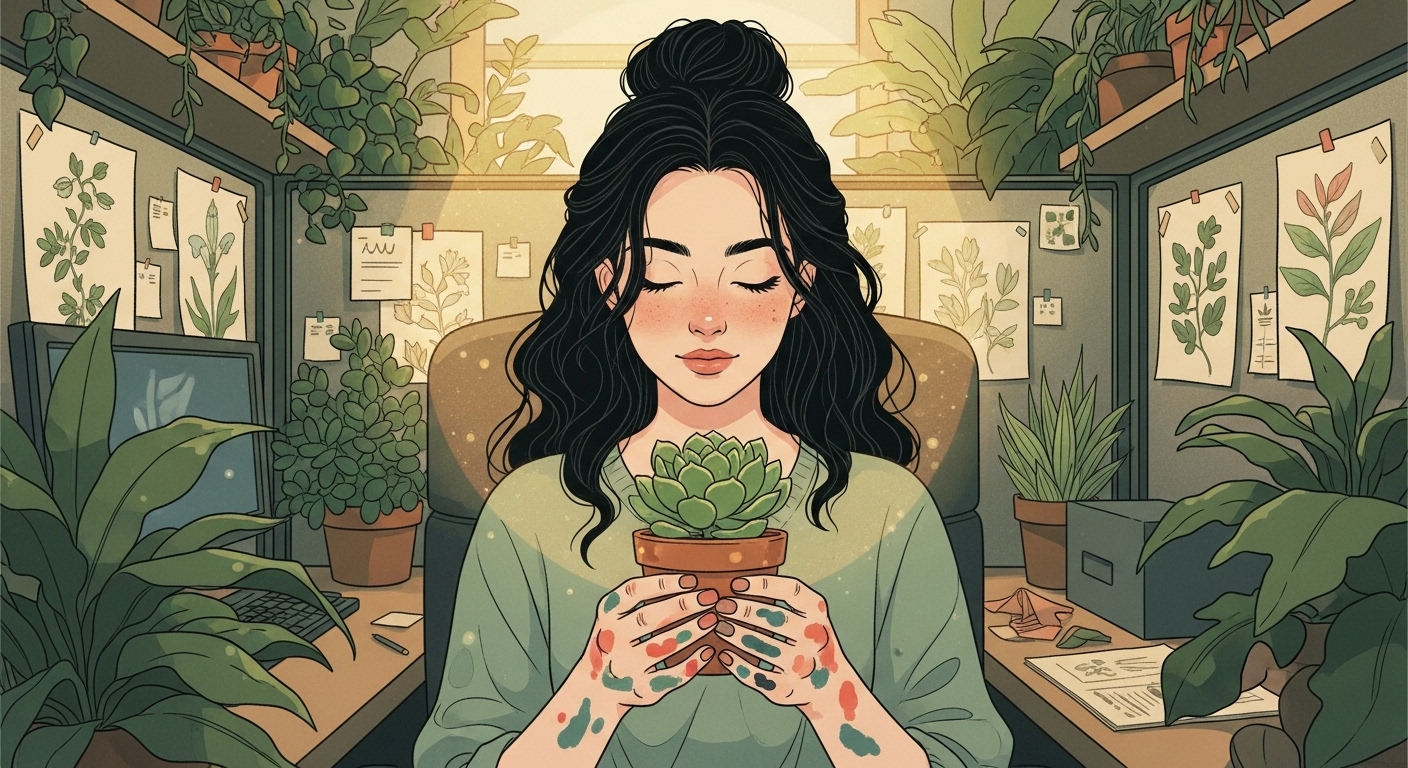
I should be good at sleep. That’s what people assume. The plant woman, the one who left consulting to grow things, who talks about soil and roots and the intelligence of seeds. Surely she drifts off easily, wrapped in some kind of botanical peace.
I don’t.
Some nights my mind runs hot. I lie in bed and replay conversations. I rearrange my propagation shelves mentally. I worry about the fiddle-leaf fig that’s been dropping leaves. I compose emails I’ll never send. The thoughts stack up like trays in a cafeteria kitchen, clattering, sliding, never quite settling.
This used to make me feel like a fraud. How could I teach people about grounding and presence when I couldn’t even find my way to unconsciousness at midnight? Then one evening, checking on my prayer plant before bed, I watched its leaves fold upward for the night. Slowly. Deliberately. And I thought: Oh. Even plants have to actively prepare for rest.
That’s when I started building a meditation for sleep around what plants already know how to do.
What Plants Know About Rest
Plants don’t just passively go dark when the sun sets. They do real, measurable work to wind down.
Prayer plants fold their leaves upward at dusk. Legumes close their leaflets. Sunflowers, which spend all day tracking the sun across the sky, slowly reorient eastward overnight so they’re ready for dawn. Photosynthesis slows. Growth hormones shift. The whole organism transitions into a different mode. Not dead, not off. Resting.
Scientists call these circadian rhythms, same word they use for ours. Plants have internal clocks tuned to light and dark, and those clocks trigger physical changes that prepare the body for nighttime.
None of this happens instantly. A prayer plant doesn’t snap its leaves shut. It takes about twenty minutes, sometimes longer. The folding is gradual, almost lazy. The whole plant gives itself permission to slow down in stages.
We don’t do that. We scroll our phones until 11:47pm, put them on the nightstand, close our eyes, and wonder why sleep won’t come. We expect to switch states like flipping a light off. But we’re biological. We’re closer to the prayer plant than we think.
A good bedtime meditation works the same way those closing leaves do. It gives you a structure for winding down gradually, so by the time you’re ready to sleep, your body has already begun the transition.
The Evening Soil Practice
This is my core sleep meditation. It’s a body-scan technique, but instead of clinical language about “releasing tension in your left quadricep,” I want you to imagine something you can actually feel.
Lie down. Get your blankets right. Feel the mattress taking your full weight. Now imagine that instead of a bed, you’re lying on a wide stretch of warm, dark garden soil. Late summer soil, the kind that’s been holding heat all day. It smells like rain and minerals and something almost sweet.
Start at your feet. Feel them sink into that warm earth. Not being swallowed. Just held. The soil rises slightly around your heels, your arches, the way it does when you press your bare foot into a freshly turned bed. Let the warmth move up through your ankles.
Now your calves. Your knees. Each part of your body releasing its weight into the ground. The soil is patient. It doesn’t rush you. It’s been here longer than anything you’re worried about.
Your hips settle. Your lower back, which has been clenching all day whether you noticed or not, softens into the earth. Imagine the day’s tension dissolving downward like water soaking into dry ground. The argument from the morning. The email you forgot to send. The low hum of worry you’ve been carrying since Tuesday. Let it all filter down through the soil, layer by layer, until it reaches somewhere deep enough to become compost. Something useful, eventually. But not your problem tonight.
Your shoulders drop. Your jaw unclenches. The soil cradles the back of your skull, warm and heavy.
You are held. The earth does this without effort. Holding things is what it does.
Stay here as long as you need. If your mind wanders, that’s fine. Just feel the warmth again. Feel the weight of your body being accepted completely.
The Closing Leaves Breath
Once you’ve settled into the soil practice, or on nights when you need something simpler, try this breathing technique. I use it when my thoughts are especially loud.
Breathe in slowly through your nose for a count of four. As you breathe out for a count of six, picture one thought, one worry, one plan for tomorrow as a single leaf. Watch it fold closed. Not crumpled, not torn off. Just folded gently, the way a prayer plant tucks in for the night.
Next breath. Another leaf closes. The presentation you’re nervous about. Fold.
Next breath. The thing your friend said that’s still sitting in your chest. Fold.
The thoughts are still there. You’re just telling them: I see you, and you can rest now. We’ll open again in the morning.
The longer exhale is the key. That extended out-breath activates your parasympathetic nervous system, which is just your body’s built-in version of nightfall. It’s the same signal that tells your prayer plant to fold. The same signal that tells the sunflower to stop tracking and start resetting.
Some nights I fold three leaves and I’m gone. Other nights it takes fifteen or twenty. Both are fine. The practice isn’t about speed. It’s about giving your nervous system a repeated, gentle cue that it’s safe to stop.
Building an Evening Ritual
Meditation for sleep works best when it’s part of a larger wind-down. A plant doesn’t flip a switch at sunset. Its chemistry has been shifting for the better part of an hour before that.
Here’s what my actual evening looks like. Not idealized, not always perfect.
About an hour before I want to be asleep, I put my phone in the kitchen. Not my bedroom. The kitchen. This was the single hardest change I made, and the one that mattered most.
I make tea. Usually chamomile or lemon balm from the plant on my fire escape. I let it steep while I do one last walk through my apartment, checking on plants. This takes five minutes. I’m looking at leaves, feeling soil moisture with my fingertip, pinching off anything dead. My hands are busy with something alive, and my brain quiets down when my fingers have a job.
Then I dim the lights. Not all the way. Just enough that the apartment starts to feel like dusk. I wash my face. Brush my teeth. Boring, ordinary things, but I try to actually feel them instead of sleepwalking through. The cool water on my eyelids. The mint sharp on my tongue.
By the time I get to bed and begin the soil practice or the closing leaves breath, my body has already had thirty or forty minutes of gradually decreasing stimulation. I’m not going from sixty to zero. I’m going from twenty to five. The meditation just carries me the rest of the way down.
If you’re just starting with sleep meditation, don’t try to build the whole ritual at once. Start with the breathing. Just the closing leaves breath, in bed, lights already off. Do it for a week. Then maybe add the phone-in-the-kitchen part. Then the tea. Let the ritual grow the way a garden does, one plant at a time.
If you want a daytime companion to this, the seed meditation is where I’d start. And if you want to hear more about how I ended up talking to plants for a living, Episode 3 of Waylight Stories covers that. You can find all episodes here.
Sleep Meditation Stories: Why Narratives Help You Drift Off
Everything I’ve described above is a technique. Useful, real, something you can do tonight. But I’ve found that stories add something the techniques can’t do on their own.
Meditation stories work for sleep because they give your brain a gentle job. Instead of lying there trying not to think — which is like trying not to hear a siren — you follow a narrative. Your mind has somewhere to go that isn’t your to-do list. The story slows, your breathing slows with it, and somewhere between the second paragraph and the third, you’re gone.
My sleep meditation stories tend to be nature-based. Gardens at dusk. Rain falling on a tin roof. A path through a forest that gets quieter with every step. The sensory details do the same thing the soil practice does — they anchor you in something warm and physical — but the narrative gives your brain something to do besides spin.
I’ve written more about this in meditation stories for sleep, including three specific stories you can try tonight. And if you want to browse the full collection of meditation stories — for sleep, anxiety, stress, or just getting started — that’s a good place to browse.
Goodnight
It’s late where I am. The prayer plant by my bed has already folded. The grow lights clicked off an hour ago, and the apartment smells like damp soil and the last of the lemon balm in my mug.
I’m going to check the basil. Close a few leaves of my own.
Sleep well tonight. And if you don’t, that’s okay. The light comes back. It always does.
About Luna Rivers
Nature-Based Meditation Teacher & Urban Gardening Advocate
Luna Rivers is a nature-based meditation teacher and urban gardening advocate. She teaches plant meditation, forest bathing, and seasonal awareness, with a focus on helping city people slow down and pay attention to the natural world around them.
You might also enjoy
Meditation Stories for Sleep: Calming Narratives to Quiet Your Mind
Racing thoughts at bedtime? Meditation stories use narrative to slow your mind naturally. Learn why stories work better than silence for sleep, and try Luna Rivers' nature-based sleep stories.
Bedtime Meditation Stories for Adults Who Can't Turn Off Their Brain
You're not a child who needs a bedtime story. Except — you kind of are. Why bedtime meditation stories work for adult brains, and how nature narratives help you finally stop thinking and sleep.
Nature Meditation Stories: Plant Wisdom for Inner Growth
You don't need to be in nature to practice nature meditation. Luna Rivers' plant-based meditation stories use botanical wisdom to ground you from anywhere — your desk, your subway seat, your bedroom.