Meditation Stories for Sleep: Calming Narratives to Quiet Your Mind
Racing thoughts at bedtime? Meditation stories use narrative to slow your mind naturally. Learn why stories work better than silence for sleep, and try Luna Rivers' nature-based sleep stories.
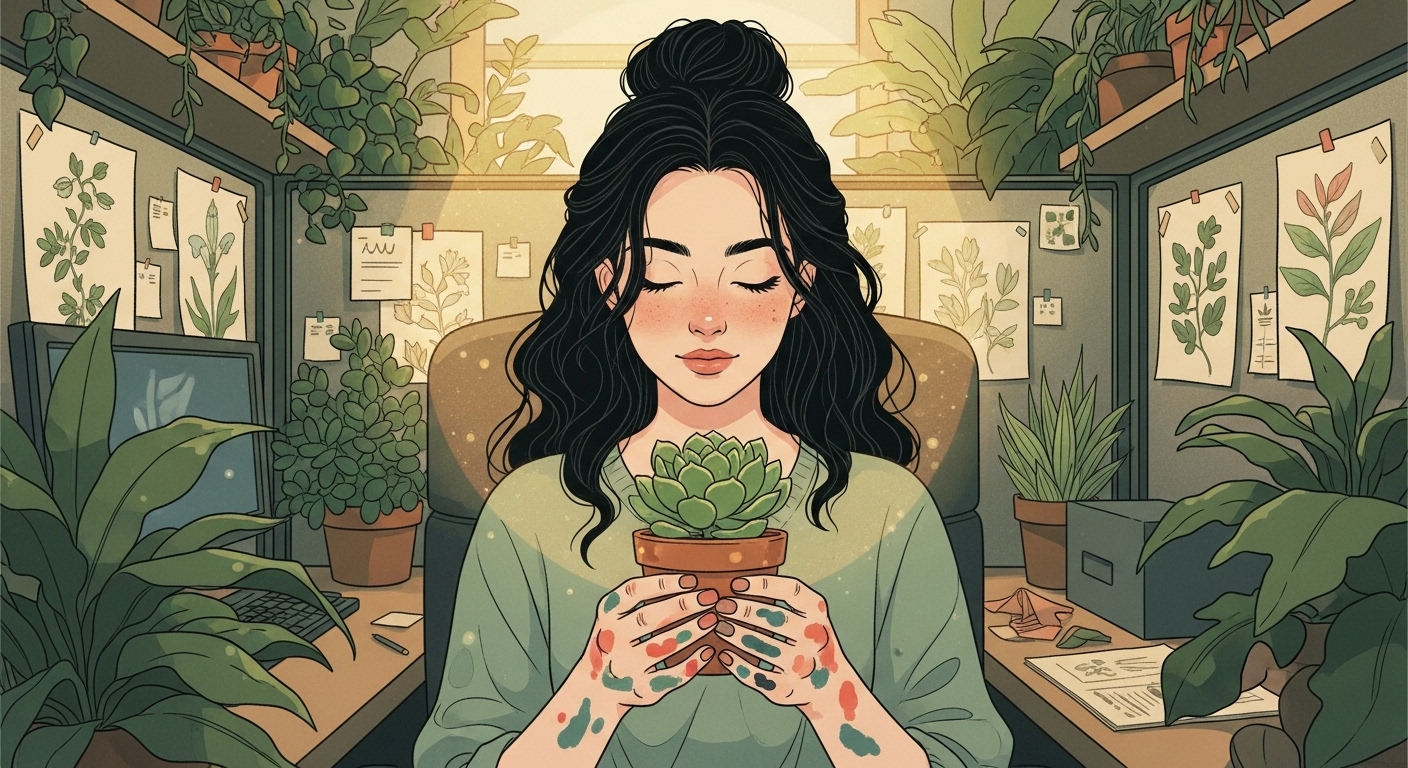
I wrote a whole post about meditation for sleep. The body scan, the closing leaves breath, the ritual of putting my phone in the kitchen. I meant every word of it. And still, some nights, none of it was enough.
The worst nights weren’t the anxious ones. Those I could at least name. The worst were the nights when my mind was just… busy. Not panicking. Not spiraling. Just narrating. Recounting the day like a sportscaster who wouldn’t stop talking. I’d lie there in my warm-soil body scan, feeling my feet sink into imaginary earth, and my brain would say, Yes, lovely, also did you remember to water the calathea, and what was that tone in Sarah’s voice at lunch, and do you think the basil is getting enough light on the east shelf?
Silence gave my thoughts room to multiply.
What finally helped, on those particular nights, was something I almost dismissed as childish. Stories. Not instructions. Not guided breathing cues delivered in a smooth voice over ambient synth pads. Actual narratives, with a place and a character and something unfolding slowly enough to follow. The kind of thing someone might have told you before bed when you were small, except designed for an adult brain that has forgotten how to stop producing content.
That’s what this post is about. Not the breath techniques or the body scans (those still matter, and I still use them). This is about the other tool. The one that works when your mind needs something to hold onto instead of something to let go of.
Why Stories Help You Sleep Better Than Silence
Here’s what I’ve noticed about my prayer plant at night. It doesn’t go still. It moves. The leaves fold upward in a slow, continuous motion that takes about twenty minutes. There’s no moment where the plant is just being quiet. It’s actively doing something — it’s just doing something that leads toward rest.
Your brain works the same way. Tell it to be silent and it panics a little. Silence is a vacuum, and your mind will fill it with whatever’s lying around. The rent check. The weird mole on your shoulder. The text you probably should have worded differently. You can’t just subtract thought. You have to give it somewhere gentle to go.
Researchers call this narrative transport. When you follow a story, your attention shifts from your own internal monologue to someone else’s scene. Your brain doesn’t shut off. It redirects. It moves from the anxiety channel to the story channel, and the story channel isn’t generating adrenaline or cortisol because nothing in a sleep story is urgent.
There’s a physical layer to this too. When a story describes the smell of wet pine needles, or the weight of a wool blanket, or the sound of water moving over smooth stones, your nervous system responds to those details almost as though you’re there. Sensory language activates the parasympathetic system, the body’s own version of dusk. Your heart rate drops. Your breathing slows. Not because you’re trying to relax, but because you’re following a description of a relaxing place, and your body can’t entirely tell the difference.
That’s why a good meditation story for sleep does something silence can’t. It gives your mind a direction and your body a cue at the same time, without asking you to do any work.
Luna’s Approach to Sleep Meditation Stories
My meditation stories are rooted in the same places where I find my own calm. Gardens at twilight. The hour before rain. Forests thick enough that sound changes quality when you walk into them. I write from what I know, and what I know is plants, soil, weather, the particular hush that falls over a greenhouse after the misters shut off.
But the stories aren’t just settings. They have pacing built into their structure. The sentences get longer as the story deepens. The details get softer. Descriptions shift from visual (what you can see) to tactile and auditory: what you feel against your skin, what you hear at the edge of hearing. This isn’t random. Visual detail stimulates; tactile and auditory detail soothes. A sleep story should migrate you from one to the other.
I think of it like a prayer plant folding. The story begins slightly open, slightly engaged. Then it starts closing, leaf by leaf, until you’re somewhere dim and warm and barely narrative at all. Just sensation. Just breath. Just the feeling of being held by something that doesn’t need anything from you.
Every story I record for Waylight Stories follows that arc. I don’t time them with a stopwatch, but they all move from a walking pace to a resting pace within about fifteen minutes. Some people fall asleep in the first five. Others ride the whole story to its end and drift off in the quiet that follows. Both are fine. The story is a bridge, not a destination.
3 Sleep Meditation Stories to Try Tonight
I want to give you a taste. These aren’t full stories — those live on the podcast — but they’re enough to show you the shape of what I mean. Try reading one slowly to yourself in bed tonight, or better yet, have someone read it to you.
The Evening Garden
You’re standing at the gate of a small walled garden just after sunset. The sky is a bruised purple, going dark at the edges. The gate is wooden, paint peeling in soft curls, and it swings open without resistance.
Inside, the gravel path is still warm from the day. You can feel it through your shoes, or maybe you’ve taken them off. The lavender bushes along the border are releasing their last breath of the day — that heavier, sweeter version of their daytime scent that only shows up when the air cools. You trail your fingers across the tops of them as you walk.
There’s a stone bench at the center of the garden, still holding the sun’s heat. You sit. The stone is smooth and warm beneath you. A single moth circles the white roses near the wall. Somewhere past the garden, a neighbor’s window glows orange and then goes dark.
What it practices: Sensory grounding through slow environmental detail. The warmth motif gives your body permission to settle. Read it once, then close your eyes and walk the garden again from memory.
Rain on the Rooftop
You’re lying in a small attic room with a sloped ceiling and one window cracked open an inch. The bed is low, the quilt heavy. You can smell the rain before you hear it — that mineral, almost metallic sharpness that means the sky is about to open.
Then it starts. Not all at once. A few drops on the roof above you, irregular, like someone tapping a question. Then more. Then steady. The sound fills the room the way water fills a bowl, from the edges inward, until there’s nothing else. Just rain on old shingles, close enough to feel personal. Like it’s falling for you specifically.
The window lets in a cool thread of air that smells like wet pavement and crushed leaves. It reaches your face and nowhere else. The rest of you is warm under the quilt. You can hear the rain change pitch as it finds the gutter, the downspout, the puddle forming on the flat stone below. Each surface gives the water a different voice.
What it practices: Auditory immersion. Rain sounds are among the most effective sleep cues because they’re complex enough to hold attention but carry no information your brain needs to process. This story layers the sound gradually so your mind is occupied without being stimulated.
The Quiet Forest Path
You’re walking a trail through old-growth trees in the last gray light before dark. The canopy is so thick that nightfall happens earlier here than in the open. The air is cool, damp, still. Your feet land on a carpet of pine needles so deep you can feel them compress, springy and slightly soft, like walking on something alive.
The path curves gently, and with each turn you leave something behind. The noise of the road you came from. The bright sky. The sense that you need to be somewhere. The trees grow closer together. The light dims another shade. A creek appears beside the path, so quiet you hear it before you see it — a thin sound, like a whisper that doesn’t need an answer.
You find a clearing. Not a dramatic one. Just a place where the trees step back slightly and the pine needles are deeper and the ground is level and soft. You lie down. The trees stand around you like old friends who don’t need to talk. The sky above is a small circle of darkening blue, framed by branches. Something in you recognizes this. You’ve been walking toward rest, and now you’re here.
What it practices: Progressive relaxation through narrative movement. Each curve in the path is a cue to release something. The forest gets quieter as you go deeper, which mirrors the way your own awareness should narrow as you approach sleep. The clearing is the body scan without calling it one.
How to Use Meditation Stories for Better Sleep
A story works best when you’re already partway down. If you go from a full-speed evening (screens, conversations, mental task lists) straight into a meditation story, it’s like asking a plant to fold its leaves at noon. The signal doesn’t land because the context is wrong.
My recommendation: pair the story with even a stripped-down version of the evening ritual I described in the sleep meditation post. Put your phone somewhere that isn’t your pillow. Dim the lights. Let ten or fifteen minutes pass between your last screen and your first story. You don’t need the full tea-and-plant-check routine I do. You just need a gap. A little dusk between your day and your story.
Then, about fifteen to twenty minutes before you want to be asleep, start the story. Audio is better than reading for this — your eyes should be closed, and the darkness behind your eyelids becomes the canvas the story paints on. Phone face-down, or use a speaker so the screen isn’t glowing at you. Let the story run. Don’t try to stay awake for the ending. Missing the ending is the point.
If you’ve practiced the Closing Leaves Breath from the other post, try three or four rounds of it before you press play. The extended exhale shifts your nervous system toward rest, and the story picks up from there. The breath is the dimmer switch. The story is the darkness that follows.
Some nights you’ll be asleep in five minutes. Some nights the story will end and you’ll still be awake, and that’s when the breath practice or the soil body scan can carry you the rest of the way. Think of it as layers, not a single solution. You’re building a garden of tools, and different nights need different plants.
Meditation Stories vs. Sleep Apps
Most sleep apps give you one of two things: ambient noise or guided instructions. Rain sounds on a loop. A voice telling you to relax your shoulders, now your arms, now your hands. These aren’t bad. I use rain sounds myself sometimes. But they’re missing the narrative layer, and that layer is what makes the difference on the hard nights.
Ambient noise provides cover but not direction. Your mind can wander freely behind the sound of ocean waves, and sometimes it wanders right back to your to-do list. Guided instructions give direction but can feel clinical. Relax your left foot. And if you’re someone whose brain argues with instructions (mine does), they create a weird resistance. Don’t tell me to relax. You relax.
Stories split the difference. They give your mind a path to follow without telling it what to do. You’re not being instructed. You’re being invited into a place. And because the place is fictional, there’s nothing in it that connects to your real worries. The garden has no deadlines. The forest has no email.
I talk about this more in the comparison post on story-driven meditation vs. apps, if you want the fuller picture. The short version: stories engage the same attention that anxiety uses, but they route it somewhere that leads to rest instead of alertness. That’s not a small distinction. That’s the whole game.
Start Your Sleep Story Practice
If you’re new to this, don’t overthink the entry point. Pick one night this week. Dim the lights a little earlier than usual. Put your phone somewhere inconvenient. Lie down and listen to a single story.
I’d start with one of my nature-based episodes — something with a slow pace and a lot of sensory texture. You can find them on Spotify and Apple Podcasts, or browse the full collection on the meditation stories page.
And if you want to understand more about the seed meditation I use during the day, or learn about how I ended up talking to plants for a living, those are good rabbit holes for the morning. Not tonight. Tonight is for rest.
Close a few leaves. Follow the path into the trees. I’ll meet you in the clearing.
About Luna Rivers
Nature-Based Meditation Teacher & Urban Gardening Advocate
Luna Rivers is a nature-based meditation teacher and urban gardening advocate. She teaches plant meditation, forest bathing, and seasonal awareness, with a focus on helping city people slow down and pay attention to the natural world around them.
You might also enjoy
Bedtime Meditation Stories for Adults Who Can't Turn Off Their Brain
You're not a child who needs a bedtime story. Except — you kind of are. Why bedtime meditation stories work for adult brains, and how nature narratives help you finally stop thinking and sleep.
Meditation for Sleep: An Evening Practice Inspired by How Plants Rest
Can't fall asleep? Try this evening meditation routine inspired by how plants wind down at night. A gentle bedtime meditation using breath, body awareness, and nature imagery.
Nature Meditation Stories: Plant Wisdom for Inner Growth
You don't need to be in nature to practice nature meditation. Luna Rivers' plant-based meditation stories use botanical wisdom to ground you from anywhere — your desk, your subway seat, your bedroom.