Nature Meditation Stories: Plant Wisdom for Inner Growth
You don't need to be in nature to practice nature meditation. Luna Rivers' plant-based meditation stories use botanical wisdom to ground you from anywhere — your desk, your subway seat, your bedroom.
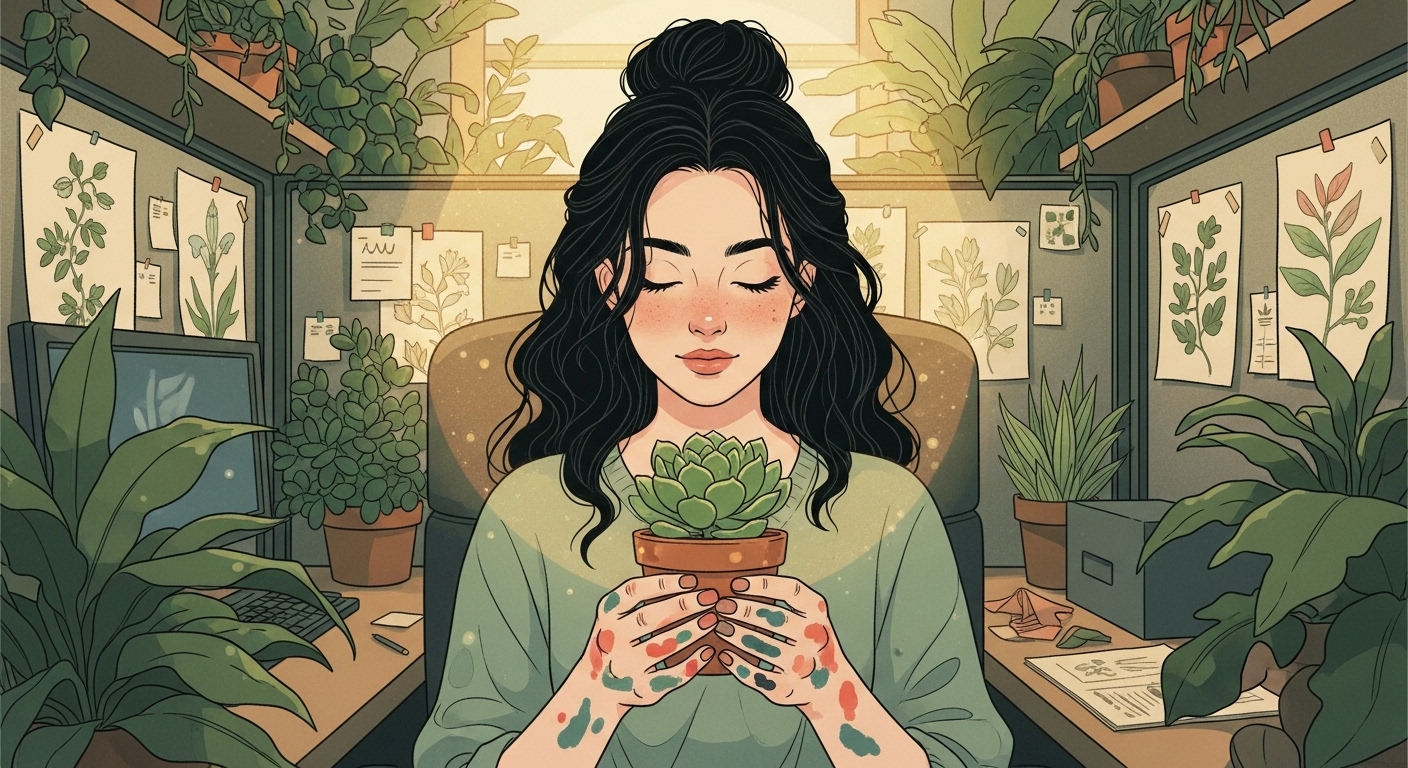
A plant can teach you everything about patience and letting go. I know that sounds like something printed on a tote bag, but I mean it literally. Watch a fern unfurl a new frond sometime. Really watch. It doesn’t check the weather first. It doesn’t plan. It just follows the warmth toward the next inch of light, and somewhere in the middle of that quiet reaching, something in your own chest loosens.
People tell me they’d love to try nature meditation, but they live in a third-floor walkup, or their commute is underground, or the closest tree is a sad ginkgo outside a bodega that smells like exhaust. They think they need a forest. A riverbank. Some kind of cinematic wilderness moment before the practice can begin.
I grew a jungle cathedral inside a studio apartment with one east-facing window and a fire escape I technically wasn’t supposed to use. I’ve meditated between monstera leaves that touched the ceiling and basil that grew in a coffee mug on my desk at a consulting firm. The natural world doesn’t require an admission ticket. It just requires your attention.
That’s what my stories do. They carry the forest to you — through narrative, through sensory detail, through the slow green logic that plants use to navigate the world. You don’t need to stand barefoot in a meadow. You need a story about standing barefoot in a meadow, and a few quiet minutes to let it take root.
Why Nature Stories Work for Meditation
There’s a word scientists use: biophilia. It means love of living things, and the hypothesis behind it says we aren’t just fond of nature — we’re wired for it. Our nervous systems developed surrounded by leaf canopy and running water and the sound of wind through tall grass. That wiring didn’t vanish when we moved indoors. It’s still there, waiting.
Here’s the part that surprised me. Research has shown that even imagining nature — visualizing a forest, picturing the texture of bark under your palm — produces measurable drops in cortisol. Your body doesn’t fully distinguish between standing in the woods and vividly imagining standing in the woods. The stress response quiets either way. Not identically, but enough to matter when you’re sitting at a desk at 3pm and your shoulders are halfway to your ears.
Nature sounds are wonderful. I keep recordings of rain and birdsong for the rougher days. But there’s a difference between ambient sound and narrative. Rain playing through a speaker is pleasant background. A story about walking through rain — the cold threading through your jacket, the way the sidewalk smells like iron and wet stone, the single yellow leaf plastered flat against your shoe — that pulls you in. Narrative asks your brain to build the world from the inside. It pulls on memory and sensation in ways that ambient noise alone can’t.
Seasonal metaphors map onto personal change so cleanly it almost feels designed. There are winters in a life: stripped back, dormant, nothing visible happening above the surface. And springs when everything pushes up at once, too fast, almost overwhelming. Plants don’t resist any of it. They don’t resent the winter for being dark. They use it. They rest, consolidate, send energy down to the roots where you can’t see it, and when conditions shift, they’re ready. No lectures needed. They just grow. Watching that cycle, or hearing a story that walks you through it, teaches something that no productivity book has figured out how to say.
Luna’s Nature Meditation Stories
I’ve been building a library of nature stories, each one rooted in a real plant, a real season, a real moment I had with dirt under my fingernails. Here are the ones I’d start with.
The Concrete Blooms Series
This is a three-part story about a seed that lands in a crack in the sidewalk. Not a garden bed. Not a greenhouse. A crack, with grit and cigarette ash and the shadow of a building falling over it for most of the day. The seed doesn’t care. It does what seeds do. It sends a root down into whatever darkness is available and starts reaching.
Part one opens with the landing. Part two is about the dark period — the stretch where nothing seems to happen but everything is happening underground. Part three is the bloom. The whole series is a metaphor for resilience, but it doesn’t announce itself that way. It just tells you about a plant growing in a sidewalk crack, and lets you feel the rest.
I wrote it for anyone who’s been told their conditions aren’t right. Wrong job. Wrong city. Wrong time. The concrete blooms story says: the conditions are irrelevant. The impulse to grow is the condition.
Seed Meditation
The seed meditation practice is my most portable technique. Four steps. No equipment. You can do it in a cubicle, on a subway platform, in a bathroom stall at a party where you’ve run out of small talk.
It grew from a moment I had holding a sixty-nine-cent succulent in a grocery store aisle, crying between the cereal boxes because I realized I’d been cut off from everything growing, including myself. That story is embarrassing and completely true, and I tell it because the best practices don’t come from retreat centers. They come from breakdown moments in fluorescent lighting.
Growing Light
Episode 3 of Waylight Stories is where I first talked publicly about botanical awareness — the practice of observing how plants respond to light and using that as a framework for noticing where you turn your own attention. What are you growing toward? What are you leaning away from? Plants answer those questions with their whole bodies. We can learn to do the same.
The Clearance Plant
And then there’s the succulent that started everything. The one from the clearance rack that my coworkers said was already dead. I brought it back to my desk, watered it with lukewarm water from the office kitchen, whispered to it during conference calls. And it came back. New green shoots pushing through brown. That plant taught me my first lesson about patience, and it cost less than a dollar.
4 Nature Stories You Can Practice Anywhere
You don’t need my podcast for these. You just need three minutes and the willingness to close your eyes.
The Windowsill Garden
Picture a single pot on a windowsill. Terra cotta, chipped at the rim, a small basil plant inside. Morning light reaches it first — a warm stripe that moves slowly across the sill like a hand sliding over a table. The basil leans into it. You can almost see the leaves adjusting, tilting their broad faces toward the warmth. Be the basil for a moment. Feel the light on your skin. Let yourself lean toward whatever warmth is available to you today, even if it’s small, even if it moves.
What it practices: presence and receptivity. When to use it: mornings, or whenever you feel like you’ve been stuck in your own shadow for too long.
Root Down
You’re standing. Maybe on linoleum, maybe on carpet, maybe on the metal floor of a train. It doesn’t matter. Imagine roots extending from the soles of your feet, pushing down through the floor, through the foundation, through concrete and rebar and compressed clay, until they reach dark, cool, undisturbed earth. Feel yourself anchored there. The surface world can shake and honk and send emails all it wants. Your roots are in something older and quieter.
What it practices: grounding during overwhelm. When to use it: the moment your pulse quickens — before a meeting, after bad news, standing in a crowd that feels too loud.
Season Change
Close your eyes. Notice how you feel right now. Not what you think — how you feel. Heavy and slow? That’s winter in you. Let it be winter. Rest. Buzzy and restless, like everything wants to move at once? That’s spring. Let things push up. Steady and warm, like long afternoons? Summer. Tired in a golden, letting-go kind of way? Autumn. There’s no wrong season. Your inner weather shifts, and naming it gives you permission to stop fighting the season you’re in.
What it practices: self-awareness and self-compassion. When to use it: during transitions — new jobs, new cities, the slow unnamed shifts that don’t have a start date but change everything.
The Old Tree
There’s a tree on my old block in Brooklyn — an oak, thick-trunked, roots buckling the sidewalk. It’s been there for at least two hundred years. It watched the street go from dirt to cobblestone to asphalt. It watched buildings rise and fall. Dogs have scratched its bark. Kids have carved initials. It lost limbs in storms and grew new ones. Imagine being that tree. Not rushing. Not going anywhere. Just standing in the same spot, growing one ring at a time, letting the street change around you. Feel how patience isn’t passive. It’s a kind of strength so quiet most people walk past it.
What it practices: patience and long-view perspective. When to use it: when you feel behind, when comparison steals your peace, when you need to remember that your timeline is your own.
Bringing Nature Stories into Your Daily Life
You don’t need an hour. You don’t even need ten minutes. The plants in my apartment don’t care about my schedule. They just need a glance, a touch, a moment of noticing. You can do the same with these practices.
Morning: Check in with one living thing. If you have a plant, touch its soil. If you don’t, look out a window and find a tree, a weed, a patch of sky. Notice it the way you’d notice a friend’s face — not analyzing, just seeing. That’s your morning practice. Thirty seconds.
Commute: Tree-spotting. Pick one piece of nature on your route and actually look at it. The grass growing through a sidewalk crack. The pigeon on the rail. The cloud. Small doses of biophilia, stacked up over weeks, change the way your body moves through a city.
Evening: Match your energy to the season. In winter, let yourself slow early. In summer, stay up with the long light if you want. My evening plant practice is built around this — winding down the way a prayer plant folds its leaves at dusk.
My own daily rhythm is simple. I wake up and walk through the apartment touching leaves. I notice which plants have moved overnight — they do move, following light, shifting orientation. On my way to wherever I’m going, I look at trees. I really look at them. And before bed, I check the soil, dim the lights, and let myself close like a leaf. That’s it. Nothing dramatic. Just a little green running through an ordinary day.
Start with Luna’s Stories
If you want to try this, I’d begin with Episode 3: Growing Light. It’s the episode where I first walk through the botanical awareness practice, and it’s gentle enough for anyone — even if you’ve never meditated, even if you’ve killed every plant you’ve ever owned.
From there, explore the full meditation stories collection or visit my page for everything I’ve recorded. If sleep is the thing you need most, start with my evening practice inspired by how plants rest — it’s the most popular thing I’ve ever made, and it works because it’s not really about sleep. It’s about giving yourself permission to close.
All episodes are on the episodes page, and wherever you listen — Spotify, Apple Podcasts, or just here on the site.
One last thing. You don’t need a green thumb for any of this. You don’t need to know the difference between a pothos and a philodendron. You just need to be willing to slow down long enough to notice something growing. The rest happens on its own.
It always does.
About Luna Rivers
Nature-Based Meditation Teacher & Urban Gardening Advocate
Luna Rivers is a nature-based meditation teacher and urban gardening advocate. She teaches plant meditation, forest bathing, and seasonal awareness, with a focus on helping city people slow down and pay attention to the natural world around them.
You might also enjoy
Seed Meditation: A 4-Step Nature Grounding Technique You Can Do Anywhere
Learn the seed meditation — a 4-step grounding technique inspired by nature. Practice this plant-based meditation at your desk, on the subway, or in any small space.
Bedtime Meditation Stories for Adults Who Can't Turn Off Their Brain
You're not a child who needs a bedtime story. Except — you kind of are. Why bedtime meditation stories work for adult brains, and how nature narratives help you finally stop thinking and sleep.
Meditation Stories for Sleep: Calming Narratives to Quiet Your Mind
Racing thoughts at bedtime? Meditation stories use narrative to slow your mind naturally. Learn why stories work better than silence for sleep, and try Luna Rivers' nature-based sleep stories.