Short Meditation Stories You Can Listen to in 5 Minutes
You don't need 30 minutes. You need 5. These short meditation stories fit between meetings, on the subway, or while your coffee brews. Practical micro-stories for packed schedules.
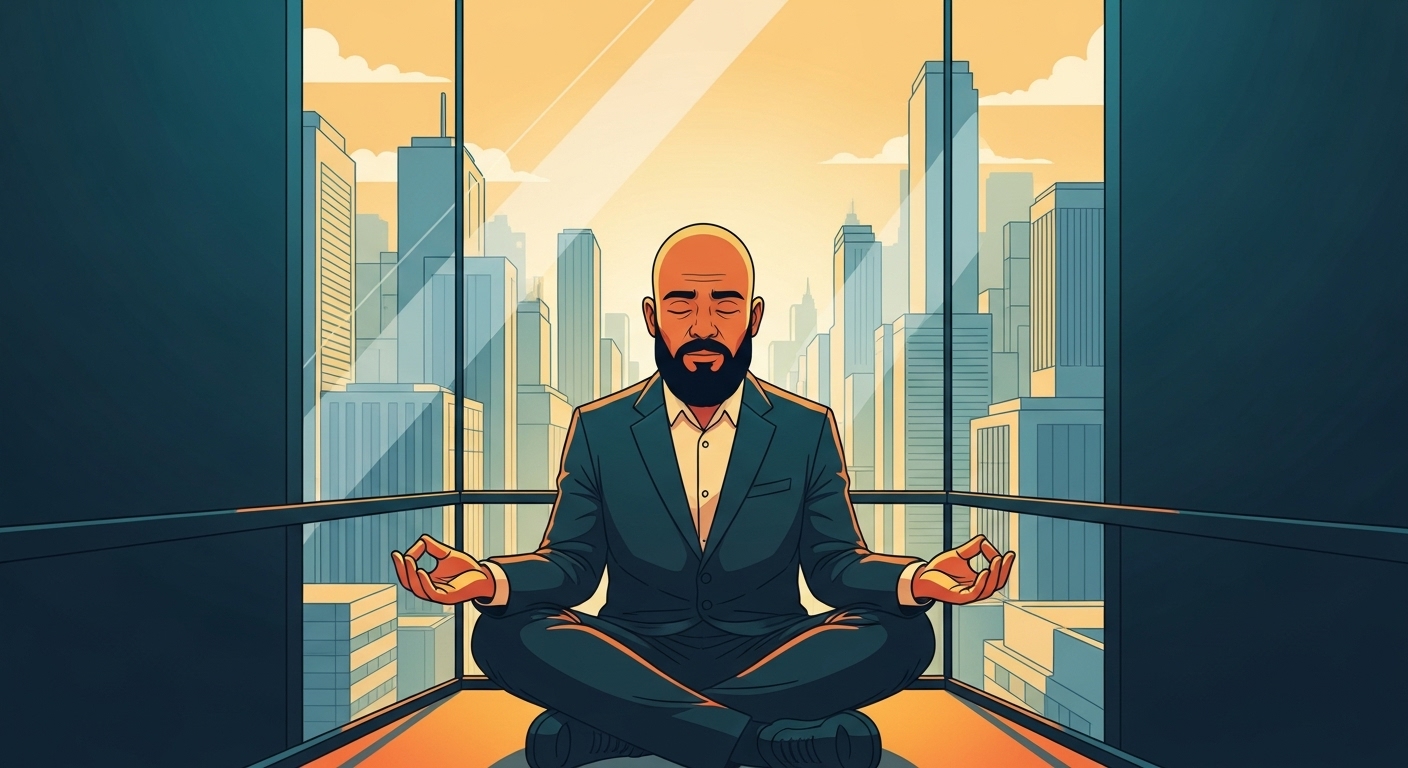
I found my first real meditation on a stalled A train somewhere under Midtown. The lights flickered. The car stopped. Everybody groaned. I had nowhere to be for approximately 90 seconds, and for once in my adult life, I didn’t reach for my phone.
That was it. Ninety seconds of accidental stillness, wedged between strangers and a guy eating a breakfast sandwich. More useful than any guided session I’d ever abandoned halfway through.
There’s this persistent idea that meditation needs runway. That you have to clear 20 or 30 minutes, find a quiet room, assume the position. I bought that story for years. Kept waiting for the mythical open block on my calendar that never showed up. Meanwhile the actual moments, the gaps, the transitions, the dead air between obligations, sailed right past me.
Short meditation stories work because they match how your brain already operates. You don’t think in 30-minute arcs. You think in bursts. A flash of worry, a spike of focus, a drift into nothing. Micro-stories meet you there. They don’t ask you to become a different person with a different schedule. They just ask for the minutes you’re already wasting.
These aren’t watered-down meditation. They’re concentrated.
Why Short Stories Work for Meditation
Here’s what nobody in the wellness industry wants to admit: consistency matters more than duration. A lot more.
A 5-minute story you actually listen to on Monday, Tuesday, Wednesday, Thursday, and Friday is worth infinitely more than a 30-minute session you do once, feel great about, then don’t repeat for three weeks. I know because I lived that cycle. I’d have one incredible sit on a Sunday morning, feel like I’d cracked the code, then proceed to skip every session until guilt dragged me back.
Micro-practices break that cycle. They’re too small to skip. Too short to dread. You can’t talk yourself out of something that takes less time than waiting for a microwave burrito.
And they compound. Three minutes today doesn’t sound like much. Three minutes every day for a year is over eighteen hours of accumulated presence. That’s more than most people get in a decade of intending to meditate someday.
This is the core of what I call Sacred Intervals — the recognition that the gaps already exist in your day. Between the elevator doors closing and opening. Between the last sip of coffee and the first email. Between parking the car and walking through the front door. Those gaps aren’t empty time. They’re just unclaimed. Short meditation stories give you something specific to do with them.
The stories also solve a problem that raw silence doesn’t: they hold your attention. Sit in silence for 5 minutes when your brain is running hot and you’ll spend 4 minutes and 50 seconds composing mental emails. But give that same brain a narrative thread (a character, a scene, a single image to follow) and it settles. Story is the oldest attention technology we have. Older than apps. Older than timers. Older than cushions.
5 Short Meditation Stories (Under 5 Minutes Each)
These are the kind of micro-stories we build at Waylight Stories. Each one is a self-contained moment. You can listen to them, or just read the descriptions below and try the practice yourself. No special equipment. No special posture. No one needs to know you’re doing it.
1. The Elevator Pause (2 minutes)
The doors close. The world shrinks to a metal box, a hum of cables, and whoever’s standing next to you pretending you don’t exist. Good. Let it shrink.
This story follows a single elevator ride from the lobby to the 14th floor. No plot. No conflict. Just the physical sensation of rising: the slight pressure in your knees, the sealed-off quiet, the way the numbers tick upward on the panel like a slow countdown to your next obligation. But for these 2 minutes, the obligation hasn’t arrived yet. You’re between floors. Between identities. Between the person who walked in from the street and the person who’s about to sit down at a desk.
What it practices: Transition awareness. Learning to notice the space between one thing and the next instead of mentally leaping ahead.
When to use it: Any vertical commute. Any waiting room. Any moment where you’re physically contained and mentally racing.
2. The Traffic Light Breath (90 seconds)
The light turns red. Your foot hits the brake. And for once — just this once — you don’t reach for your phone.
This micro-story lives inside a single red light. Ninety seconds, maybe less. The narrator watches the light, watches other drivers drumming their steering wheels, watches a pedestrian cross without looking up from their screen. Everybody in motion or impatient to be. And the narrator just breathes. Not deep therapeutic breaths. Regular ones. Noticed. Felt. Counted.
The light turns green. The story ends. That’s all there is.
What it practices: Patience with stillness. The ability to not fill every pause with stimulation.
When to use it: Driving. Waiting for a webpage to load. Any forced stop where your reflex is to grab your phone.
3. The Morning Leaf (3 minutes)
I didn’t come up with this one. Luna did. Luna Rivers has this way of seeing individual things in a world full of everything. She once spent 20 minutes watching a single raindrop move down a window. I asked her what she got out of it. She said, “I stopped needing to get anything out of it.”
That messed me up for a week.
The Morning Leaf is her influence filtered through my commute. One leaf. You pick it before you start walking, or before the train pulls away, or before the bus turns the corner. Then you just watch it. Not the whole tree. Not the whole park. One leaf, doing whatever leaves do — catching light, turning in the wind, holding still.
Three minutes of watching one thing in a world that wants you to watch everything.
What it practices: Single-point attention. The opposite of scrolling.
When to use it: Morning commute. Lunch break outdoors. Anytime you’re near something growing and not in a hurry. If Luna were writing this she’d say you’re never in a hurry, you just think you are. She’s probably right.
4. The Notification Bell (1 minute)
Aria Chen, who thinks about the relationship between technology and attention more carefully than anyone I know, taught me this one. I hated it immediately. Which meant it was working.
Your phone pings. A notification. Instead of looking at it, you listen to the sound itself. Not what it means. Not who sent it. Not what you need to do about it. Just the sound. The actual vibration in the air. One second of pure tone before your brain attaches a story to it.
Then you take one breath.
Then you look.
Aria’s version involves a longer pause and some visualization about the nature of digital signals. I stripped it down because I’m not that patient. One ping. One breath. One minute, maximum. But in that minute, you’ve broken the reflex loop, the one where stimulus and response are so tightly welded that you don’t even notice there’s a gap between them. There’s always a gap.
What it practices: Response awareness. Putting a sliver of space between stimulus and reaction.
When to use it: Every time your phone makes a sound. Which, depending on your notification settings, could be your entire meditation practice for the day.
5. The Kettle Meditation (4 minutes)
Another one I borrowed from Luna, who treats kitchens like temples and doesn’t seem to be joking about it.
You fill the kettle. You turn it on. And then, instead of walking away to check your email or scroll through headlines while the water heats, you stay. You stand there. You watch the kettle.
Nothing happens for a while. That’s the practice.
Then there’s a faint ticking as the metal expands. A low rumble building from the bottom. Steam starts to curl from the spout. The sound rises. The water reaches a boil. You pour it. Story over.
Four minutes of watching water decide to become steam. Luna says the waiting is the whole point. That we’ve forgotten how to be in a room with a process unfolding at its own speed. I think she’s right. My instinct is always to optimize the wait. Multitask. Extract value from the dead time. The Kettle Meditation is the opposite. Standing still while something takes exactly as long as it takes.
What it practices: Patience. Being present with a slow process without trying to speed it up or fill it.
When to use it: Making tea or coffee. Waiting for toast. Any kitchen moment where you’d normally drift to your phone.
How to Build a Short Meditation Story Habit
Don’t build a new habit. Attach to one you already have.
This is the only advice about habits that has ever actually worked for me. I don’t have the willpower to add a standalone meditation block to my day. I’ve tried. I’ve failed. What I can do is stack a micro-story onto something I’m already doing.
Morning coffee? That’s the Kettle Meditation. Elevator to my floor? Elevator Pause. Red light on the drive home? Traffic Light Breath. I didn’t add anything to my schedule. I just started paying attention during moments I used to sleepwalk through.
Here’s my challenge if you want one: three stories a day. Pick three transition moments in your existing routine. Morning, midday, evening. Tag each one with a story from the list above. That’s the whole system.
Track it if you want to, but use paper. A check mark on a sticky note on your bathroom mirror. Not an app. I know that’s ironic coming from someone who makes a podcast, but meditation tracking apps become one more thing to optimize. One more dashboard. One more streak to protect. A check mark on paper doesn’t send you push notifications. It just sits there, quietly honest, reminding you whether you showed up or not.
I stopped using meditation apps for tracking two years ago. My consistency went up. Coincidence? Maybe. But I think there’s something to keeping the practice analog even if the stories themselves are digital. It stays simple. It stays yours.
From Short Stories to Deeper Practice
Here’s what happens if you stick with micro-stories for a few weeks: you start wanting more.
Not because someone told you to level up. Not because an app gamified your practice with badges. You just notice that the 2-minute Elevator Pause left you curious. You start wondering what would happen with 10 minutes. Then 20. The appetite builds on its own.
That’s how it worked for me. Short practices were the on-ramp, not the destination. Though honestly, some days they’re still the whole practice. That’s fine. Not every day calls for a long sit. Some days the Traffic Light Breath is all you’ve got, and all you’ve got is enough.
When you’re ready for longer form, the full episodes are there. The characters (myself, Luna, Aria) each have arcs that develop over time. Themes that build. Ideas that come back around in different contexts. The short stories are the door. What’s on the other side is up to you and how much time you’ve got.
Start with One Story
Don’t try all five. Don’t plan a schedule. Don’t think about this too hard.
Pick one story from the list above. Whichever one matches a moment you already have in your day. Try it once. See if anything shifts. If it does, try it again tomorrow.
That’s the whole pitch. One story. One moment. Today.
If you want more micro-stories like these, the meditation stories hub has the full collection. You can learn more about how I developed this approach on my character page, or read the companion piece on 5-minute meditation practices if you want non-story alternatives.
Five minutes is generous. Ninety seconds is enough. You already have the time. You’ve always had it.
About Marcus Wu
Urban Spiritual Teacher & Mindfulness Practitioner
Marcus Wu is an urban spiritual teacher, former tech executive, and creator of Sacred Intervals. He has been teaching meditation for over 5 years, mostly to people who work in fast-paced, high-pressure jobs and need practical ways to stay grounded.
You might also enjoy
5-Minute Meditation: Four Quick Practices for People with No Time
No time to meditate? These four 5-minute meditation techniques fit into your commute, lunch break, or the gap between meetings. Practical mindfulness for packed schedules.
Micro Meditation for Busy Professionals: The Sacred Intervals Technique
Learn sacred intervals — a micro meditation technique that turns everyday moments into mindfulness practice. Just three conscious breaths, no cushion or quiet room needed.
Meditation Stories for Work Stress: The Corporate Monk's Guide
Marcus Wu had a panic attack during a board presentation. He didn't quit his job — he changed how he showed up. These meditation stories are for people who can't 'just relax.'